
The district already exceeds state requirements, but officials say the changes are about learning continuity, not legal compliance
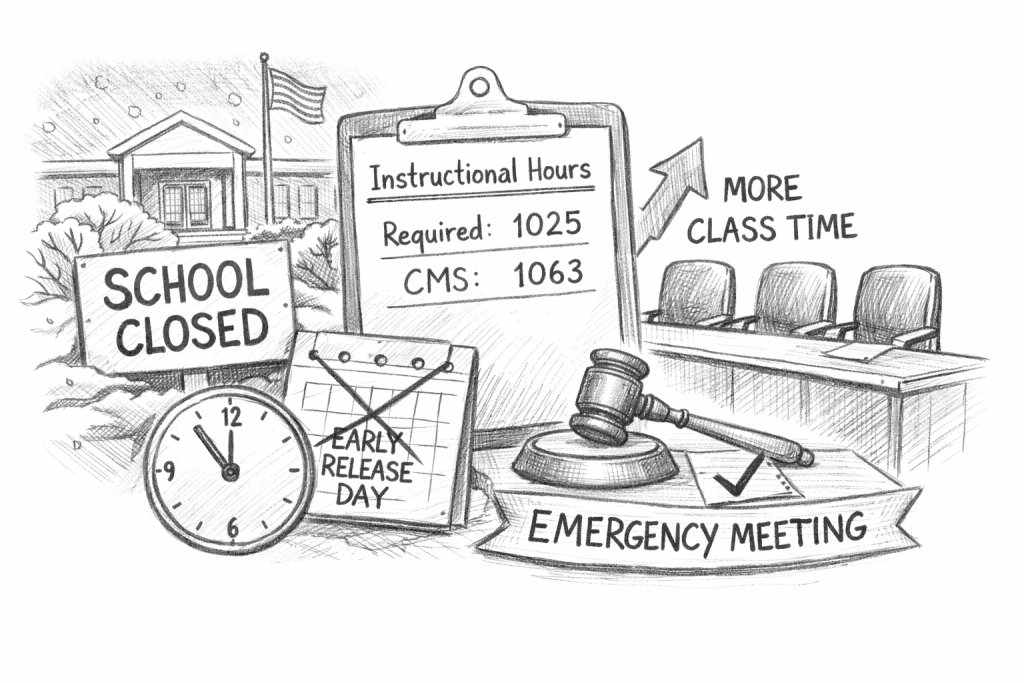
In a 20-minute emergency meeting Tuesday night, the Charlotte-Mecklenburg Board of Education unanimously voted to convert two upcoming early release days into full school days, responding to two weeks of winter weather chaos that knocked students out of their learning rhythm and highlighted a question the district didn’t legally need to answer: when is enough instruction actually enough?
The answer, for CMS, isn’t defined by North Carolina’s minimum requirements. It’s defined by what happened between January 26 and February 4.
Eight consecutive days. Some delayed. Some closed. Some remote. None normal.
“It is not lost on us that inclement weather events require so much from members of our community,” Superintendent Crystal Hill told the board. “From parents to emergency personnel, to students to school leaders and staff, and so many more.”
Hill’s recommendation was simple: take the scheduled early release days on February 11 and April 29 and turn them into regular instructional days. Not because the law requires it. Because students need it.
The vote was 9-0.
The Math CMS Didn’t Need to Do (But Did Anyway)
North Carolina requires school districts to provide either 185 instructional days or 1,025 instructional hours. CMS uses the hours model, which offers more flexibility. This year’s calendar provides 1,063 hours—38 more than required.
Chief Academic Officer Tamara Thompson walked the board through what’s been lost so far: two-hour delays on December 9, January 29, and January 30. Full closures on January 26, February 2, and February 3. Remote instruction on January 27, January 28, and February 4.
Even with all of that, CMS still exceeds the state minimum.
Thompson was precise about the math. The district still has 1,040.5 instructional hours on the calendar—15.5 hours above North Carolina’s requirement. But those numbers assume perfect weather from here forward, and February already proved that assumption fragile.
Converting the two early release days adds 12 hours back to the calendar. That brings the total to 1,052.5 hours, restoring a 27.5-hour buffer against future disruptions.
“We want to make sure that we’re doing what’s best for our students,” Thompson said.
The Rhythm Problem
Thompson laid out the February problem in stark terms. Students would return Thursday and Friday, come back Monday and Tuesday, then have a half day on Wednesday, February 11. Then they’d be off again Thursday the 16th for a teacher workday tied to Presidents Day.
The pattern wasn’t just disruptive. It was measurably so.
Thompson shared data: CMS averages 92.9% daily attendance. On early release days, that drops. October 1: 89.7%. November 19: 80.6%.
“We felt this was important data to share with you and with our community in making this decision,” Thompson said.
Board members didn’t debate the recommendation. They asked clarifying questions, expressed support, and voted.
Board member Stephanie Sneed asked whether converting early release days would affect teacher planning time. Thompson said no—teachers would still get their contractually required planning periods, just scheduled differently on those days.
Board member Sean Strain asked whether the changes would create additional costs for the district. Thompson said no—the days were already on the calendar. The district was just extending the instructional time.
What the Board Didn’t Say
What CMS didn’t mention: this isn’t the first time winter weather has forced calendar changes. It probably won’t be the last.
January and February are historically the worst months for school closures in North Carolina. Snow, ice, and freezing temperatures routinely disrupt instruction across the state. Most districts build buffer days into their calendars to absorb the disruptions without falling below state minimums.
CMS built its buffer into hours instead of days, which offers more granular flexibility. A two-hour delay doesn’t wipe out an entire instructional day—it just reduces the hours for that day. The district can then make up the lost time by converting early release days, extending the school year, or adjusting the calendar in other ways.
But that flexibility only works if the district monitors the hours closely and adjusts proactively. Which is exactly what CMS did Tuesday night.
The Vote
The board voted without discussion. Superintendent Hill presented the recommendation. Board members asked their questions. The vote was called.
Nine yeses. No debate. No dissent.
The meeting lasted 20 minutes.
Board Chair Thelma Byers-Bailey thanked staff for their work during the weather disruptions. She acknowledged the strain on families, students, and employees. She praised the district’s response.
“I just want to say thank you,” Byers-Bailey said. “Thank you for your flexibility. Thank you for your patience. Thank you for your understanding.”
The board moved to adjourn.
What Happens Next
February 11 and April 29 are now full instructional days. The February change means students will have five consecutive full days of instruction before the Presidents Day break. The April change restores hours lost earlier in the year.
Parents received notification of the changes Wednesday morning. Schools will communicate revised bell schedules for the affected days.
The district still has 27.5 hours of buffer time built into the calendar. If winter weather strikes again, CMS has options. If it doesn’t, students will end the year with significantly more instructional time than North Carolina requires.
Either way, the board made clear Tuesday night: meeting the minimum isn’t the goal. Maximizing learning time is.
📋 People Mentioned in This Article
- Crystal Hill — Superintendent, Charlotte-Mecklenburg Schools
- Tamara Thompson — Chief Academic Officer, Charlotte-Mecklenburg Schools
- Stephanie Sneed — Board Member, Charlotte-Mecklenburg Board of Education
- Sean Strain — Board Member, Charlotte-Mecklenburg Board of Education
- Thelma Byers-Bailey — Board Chair, Charlotte-Mecklenburg Board of Education
🏛️ Organizations Referenced
- Charlotte-Mecklenburg Schools (CMS)
- Charlotte-Mecklenburg Board of Education
- North Carolina Department of Public Instruction

About the Author
Jack Beckett
Jack Beckett covers education and local government for The Charlotte Mercury, with a focus on policy decisions affecting Charlotte-Mecklenburg Schools and municipal governance. His reporting emphasizes data-driven analysis and the real-world impact of institutional decisions on communities.
📄 License & Usage
This work is licensed under a Creative Commons Attribution-NoDerivatives 4.0 International License (CC BY-ND 4.0).
You are free to:
- Share — copy and redistribute the material in any medium or format for any purpose, even commercially
Under the following terms:
- Attribution — You must give appropriate credit, provide a link to the license, and indicate if changes were made. You may do so in any reasonable manner, but not in any way that suggests the licensor endorses you or your use.
- No Derivatives — If you remix, transform, or build upon the material, you may not distribute the modified material.
Suggested Attribution: “Two Half Days Become Full Ones: CMS Board Acts After Storm Chaos” by Jack Beckett, The Charlotte Mercury, licensed under CC BY-ND 4.0.
📰 About The Charlotte Mercury
The Charlotte Mercury delivers in-depth local journalism covering education, government, and community issues in Charlotte-Mecklenburg and the surrounding region. We provide context-driven reporting that helps readers understand the decisions shaping their community.
Stay Informed:
Visit Our Website |
Education Coverage |
Local Government
Article Information: Published February 4, 2026 | Reading Time: 4 minutes | Category: Education / Local Government
Topics: CMS, School Calendar, Winter Storms, Instructional Time, Board of Education, Emergency Meeting
© 2026 The Charlotte Mercury. This article is licensed under CC BY-ND 4.0.
For questions about this article or to report corrections, contact: editor@cltmercury.com