Charlotte-Mecklenburg Schools is writing a new technology policy, and on Tuesday some of the people who packed the board room in June to fight the district's reading and math software came back to tell the board what they want in it.
Schools Beyond Screens CMS, whose speakers numbered their asks from the podium, made three requests: an immediate bell-to-bell cell phone ban along with a public audit of what CMS spends on technology and what it gets for it; evidence that i-Ready works, or a parent opt-out; and tighter controls on the devices the district hands students, starting in kindergarten.
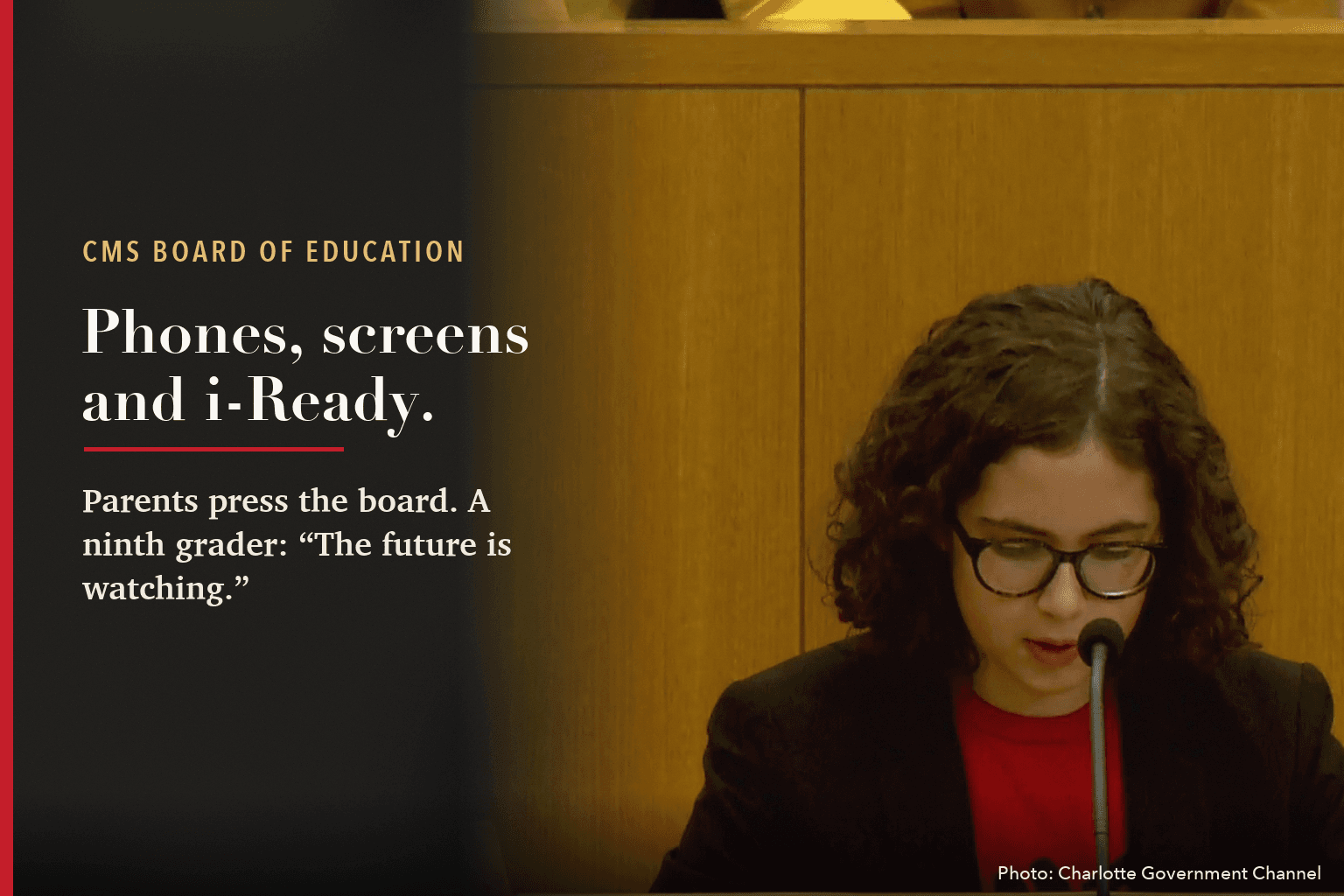
The group's last speaker was Celia Kaul, a ninth grader at J.T. Williams Secondary Montessori, who told this board in June that its new free speech policy would do the opposite of what it promised. On Tuesday she said she is required to take an online course that shows how artificial intelligence can draft her outlines and keep her notes, and that pushes AI platforms on her.
"The future is watching," she said.
The policy on the table
The board held a public hearing Tuesday on a proposed policy, A-TECH, "Technology and Future Ready Learning," which had its first reading Sept. 22. The draft says the superintendent will report to the board every year on how the policy is working, and that the report will include "an evaluation of whether the 1:1 device model remains appropriate for each grade level." The board took no vote; the hearing was closed after two speakers.
Mary Grinton, speaking for Schools Beyond Screens, said the group was "especially excited" about that line. She said the group expects the evaluation to "produce significant cost savings" in the lower grades, where, she said, evidence shows one-to-one devices do not serve children's learning. The group "tentatively" supports the draft, she said, on the understanding that the rules under it still have to be written.
Then she asked for the phone ban, to be imposed immediately, and for an audit in five parts: what CMS spends each year on platforms, licenses, devices, repairs and support, and when each contract renews; what evidence supports each platform; how much time students spend on screens each week, by grade and platform; what each vendor collects and shares about students; and how often students are on games or unrelated sites. "We cannot make responsible decisions about school technology without understanding what we are paying for and what students are experiencing," she said.
i-Ready, again
In June the board refused the multi-year i-Ready renewal its staff asked for and approved one year instead, with conditions: data by August, a plan to fold i-Ready results into the board's progress reports, security provisions, and a clause on how the vendor uses student data.
Sherri Bissell, a nurse practitioner and Collinswood PTA president who spoke against the renewal in June, said the district has since pointed to rising proficiency as proof the software works. "But those figures cannot isolate i-Ready's contribution," she said. "Student performance is influenced by teachers, curriculum, tutoring, attendance, and other factors. Post-pandemic recovery also complicates claims of improvement."
"CMS spends $4.4 million annually on i-Ready and mandates 90 minutes of instructional time each week," Bissell said. "That is a substantial financial and instructional commitment. It demands substantial evidence in return." She asked the district to evaluate outcomes over time, including pre-pandemic test results, to examine what the platform collects about students, and to survey teachers, parents and students. When board member Anna London asked whether such a community effort had been made, Bissell said, "the response was no from CMS." Her request: show the evidence, or drop the minimum usage requirement and let parents opt out.
The $4.4 million figure is Bissell's. In June, speakers put the renewal at about $18 million; the district did not confirm a contract value then.
“CMS spends $4.4 million annually on i-Ready and mandates 90 minutes of instructional time each week. That is a substantial financial and instructional commitment. It demands substantial evidence in return.”
Sherri BissellSchools Beyond Screens CMSVideo: Charlotte Government Channel
The devices
Amelia Montgomery, a mother of four with twins due to start kindergarten next year, asked the district to study how private schools and other districts lock down student devices. CMS, she said, "too often appears to be playing whack-a-mole," blocking one game or one site after it reaches an administrator while "students are just continuing to find the tons and tons of distractions." She asked for web filtering, application controls, browser restrictions and a process for exceptions, so that technology "serves instruction instead of competing with it."
A stay-at-home father of four, none of them in CMS yet, said he was shocked to learn that kindergartners are handed an iPad on arrival. Some people in his community who once assumed their children would go to the neighborhood school, he said, now talk about private schools and vouchers. "Kids should be learning how to read, not how to swipe," he said. "I truly believe that technology is the new smoking. Please stop giving our kids cigarettes."
Allie Kaul, a former educator, said the term digital divide "no longer means what it once did." "Parents who have the time and money are investing in children playing outside, participating in collaborative experiences, and connecting with peers and trusted adults," she said. "Foundational education should be rooted in human connection, not internet connection."
The district began a four-phase review of screen time and instructional technology in August, with first findings due this month and draft plans for 2027-28 due to the board in April.
"The future is watching"
Celia Kaul, a public school student for nine years, described a Montessori education built on physical materials, field trips and one-on-one lessons.
"But I am forced to take a Canvas course detailing how AI can help me draft outlines and keep track of notes and encourage me to use AI-based platforms like Gemini Notebook," she said. "I start to doubt the priorities of the board."
"Most of my teachers work two jobs and long, unpaid hours after school. They're not doing this job for the money," she said. "AI is not the solution to this." When the board spends "millions of dollars in order to get the newest technology and the most updated systems instead of focusing on value and compensating educators," she said, "it feels like this board is not as committed to the future as it claims to be."
"We are the voice of the future, not asking for radical change, but transparent and responsible practice. We matter, our voices matter, and our futures matter. The future is watching."
“We are the voice of the future, not asking for radical change, but transparent and responsible practice. We matter, our voices matter, and our futures matter. The future is watching.”
Celia KaulNinth grader, J.T. Williams Secondary MontessoriVideo: Charlotte Government Channel
The board thanked the speakers and moved on. Tuesday's agenda listed A-TECH as a public hearing only; no vote on it was scheduled.