
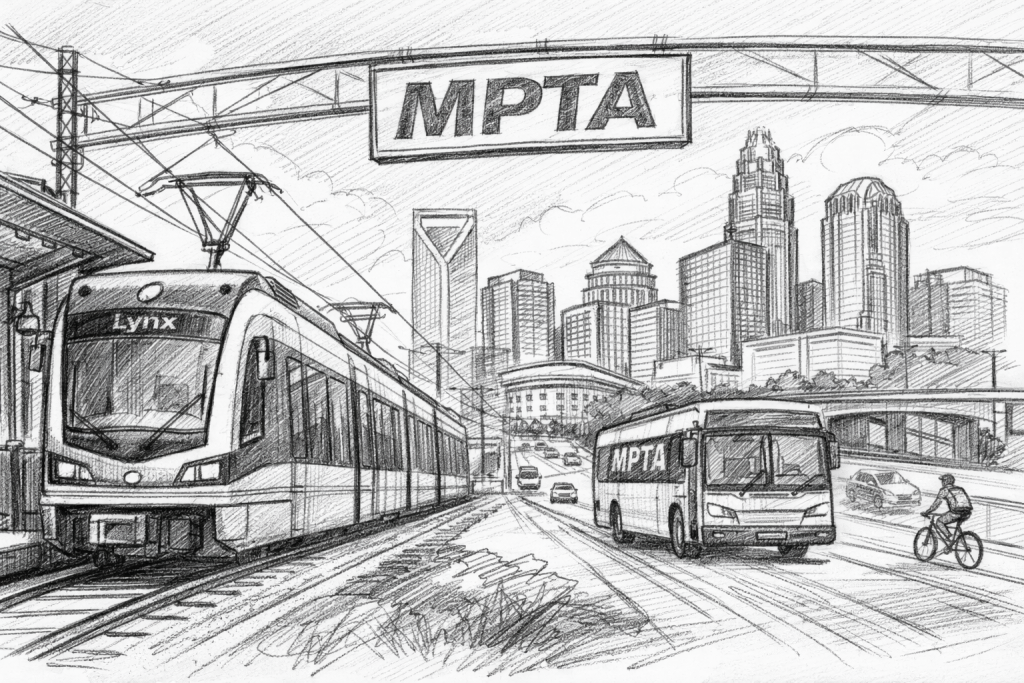
Transit power explained
Charlotte and Mecklenburg County have quietly crossed a governance threshold that will shape transportation, land use, and public spending for a generation.
On December 18, the Metropolitan Public Transportation Authority convened for the first time. The meeting was ceremonial in form, procedural in substance, and consequential in effect. By the time the gavel fell, a new regional power center was fully constituted, officers elected, governing rules adopted, and the legal groundwork laid for one of the largest public infrastructure undertakings in local history.
This is not a transit announcement. It is a transfer of authority.
What the MPTA actually is
The MPTA is a regional public authority created under North Carolina’s P.A.V.E. Act after Mecklenburg County voters approved a one-cent sales tax dedicated to transportation. Over roughly 30 years, that tax is expected to generate close to $20 billion.
Unlike the Charlotte Area Transit System, which operates buses and trains, the MPTA controls strategy, prioritization, and money. It decides what gets built, when it gets built, and how funds are allocated across rail, buses, roads, and related infrastructure.
Once projects are approved and money committed, those decisions are extraordinarily difficult to reverse.
Why the first meeting mattered more than it looked
At first glance, the inaugural meeting resembled many Charlotte civic ceremonies: color guard, invocation, elected officials praising collaboration and regional unity.
But beneath that surface, several durable decisions were made.
The board:
- Swore in all 27 trustees
- Randomly assigned staggered term lengths to establish long-term continuity
- Elected its permanent leadership
- Adopted governing rules
- Accepted and published the legally required transition studies that govern how power moves from the City of Charlotte to the new authority
In practical terms, the MPTA is no longer theoretical. It is operational.
A recurring theme: unity, with friction underneath
Mayors from across Mecklenburg County used their remarks to emphasize regional cooperation, but not all spoke from the same place.
Charlotte Mayor Vi Lyles framed the authority as the culmination of years of work and urged the board to avoid repeating past mistakes, particularly displacement tied to transit-driven development.
Davidson Mayor Rusty Knox described the MPTA as a test of whether the region can be a national model for safe, reliable public transit at a moment when public confidence is fragile.
Huntersville Mayor Christy Clark emphasized transit as lived infrastructure: nurses getting to shifts, students reaching campuses, seniors maintaining independence.
Matthews Mayor John Higdon struck a different note. He acknowledged that much of southeast Mecklenburg opposed the sales tax and warned the board not to treat those voters as an afterthought. His message was blunt: trust will have to be rebuilt with tangible benefits, not speeches.
That tension — between regional ambition and uneven geographic confidence — is likely to define the board’s early years.
Leadership choices and what they signal
The board unanimously elected David Howard as its inaugural chair. Howard, a longtime civic figure, used his first remarks to stress equity and continuity, noting the symbolic importance of holding the first meeting on Charlotte’s west side.
Frank Emory was elected vice chair, bringing deep experience in transportation law and governance.
Christy Long was elected secretary after a contested vote, highlighting her background in risk, controls, and institutional setup.
Ned Curran was elected treasurer.
These roles matter. The chair controls agendas. The secretary shapes records and process. The treasurer oversees financial integrity. Early leadership choices tend to echo through an authority’s culture.
The legal reality check: debt, assets, and time
The most substantive portion of the meeting came not from elected officials, but from attorneys and consultants presenting the studies required by the P.A.V.E. Act.
Their conclusion was carefully worded but clear: transferring transit assets, liabilities, and operations from the City of Charlotte to the MPTA is feasible and advisable, but not immediate.
Key constraints include:
- Existing CATS debt cannot transfer to the authority
- Assets tied to that debt cannot move until obligations are retired
- Federal and state grants require separate approvals before transfer
- Employees cannot shift without benefit and pension structures in place
In short, the transition will be phased. For a time, the city and the authority will operate in parallel, connected by interlocal agreements.
The board approved the studies with explicit language reserving its right to pursue alternative approaches. That clause was not decorative. It preserves flexibility if legal, financial, or political conditions change.
The money question, in practice
State law locks in broad funding categories:
- 40 percent rail
- 40 percent roads and related infrastructure
- 20 percent buses and microtransit
What remains open is project sequencing and geographic distribution. The Red Line commuter rail, for example, must reach a specified level of completion before other rail corridors advance. That requirement will shape priorities whether the board likes it or not.
The full MPTA board and initial terms
Below is the complete list of the 27 trustees, with initial term lengths determined by lot at the inaugural meeting.
Mecklenburg County Appointees
- Justin Harlow – 4-year term
- Dané (phonetic) Davis-Steadman – 2-year term
- Sealy (first name unclear) – 4-year term
- Shore (first name unclear) – 4-year term
- Isol / Isolée (phonetic) – 2-year term
- Bryant (first name unclear) – 2-year term
Town Appointees
- Walt (Town of Davidson) – 4-year term
- Danish Tujenki (Town of Matthews) – 2-year term
- Brad Simmons (Town of Mint Hill) – 2-year term
- Robbins (Town of Pineville) – 4-year term
- Menzo / Menzel (Town of Cornelius) – 4-year term
- Anthony Lindsay (Town of Huntersville) – 2-year term
General Assembly Appointees
- Erin (NC Senate appointee) – 2-year term
- Longo (NC House appointee) – 4-year term
City of Charlotte Appointees
- Young – 4-year term
- Pruitt – 4-year term
- Papas – 2-year term
- Nolly / Nali – 4-year term
- Reverend Corinne Mack – 4-year term
- Christy Long – 2-year term
- David Howard – 2-year term
- Zavada Griffin – 4-year term
- Emory – 2-year term
- Dixon – 4-year term
- Collins – 2-year term
- Bowman – 2-year term
What happens next
The board must now:
- Establish a regular meeting calendar
- Begin negotiating interlocal agreements with the City of Charlotte
- Start defining project evaluation criteria
- Engage the public before priorities harden into contracts
None of this will move quickly. But once it moves, it will move with force.
The most important decisions will not arrive as ribbon cuttings. They will arrive as agenda items.
About the Author
Jack Beckett is a senior writer at The Charlotte Mercury, where he covers transportation, governance, and the quiet mechanics of power. He drinks his coffee black, reads agenda packets for sport, and believes most civic decisions happen long before anyone is looking.
You can explore more of our work at News, dive into how power functions locally at Politics and City Council, track land-use decisions at Zoning and Housing, or browse neighborhood life at Culture. Learn who we are at About Us and how we protect your data at Privacy Policy. You can always message us on X, or Twitter, or as we call it Twix, at x.com/queencityexp.
Creative Commons License
© 2025 The Charlotte Mercury / Strolling Ballantyne
This article, “What You Need to Know About Charlotte’s New Transit Authority,” by Jack Beckett, is licensed under CC BY-ND 4.0. “What You Need to Know About Charlotte’s New Transit Authority”
by Jack Beckett, The Charlotte Mercury (CC BY-ND 4.0)