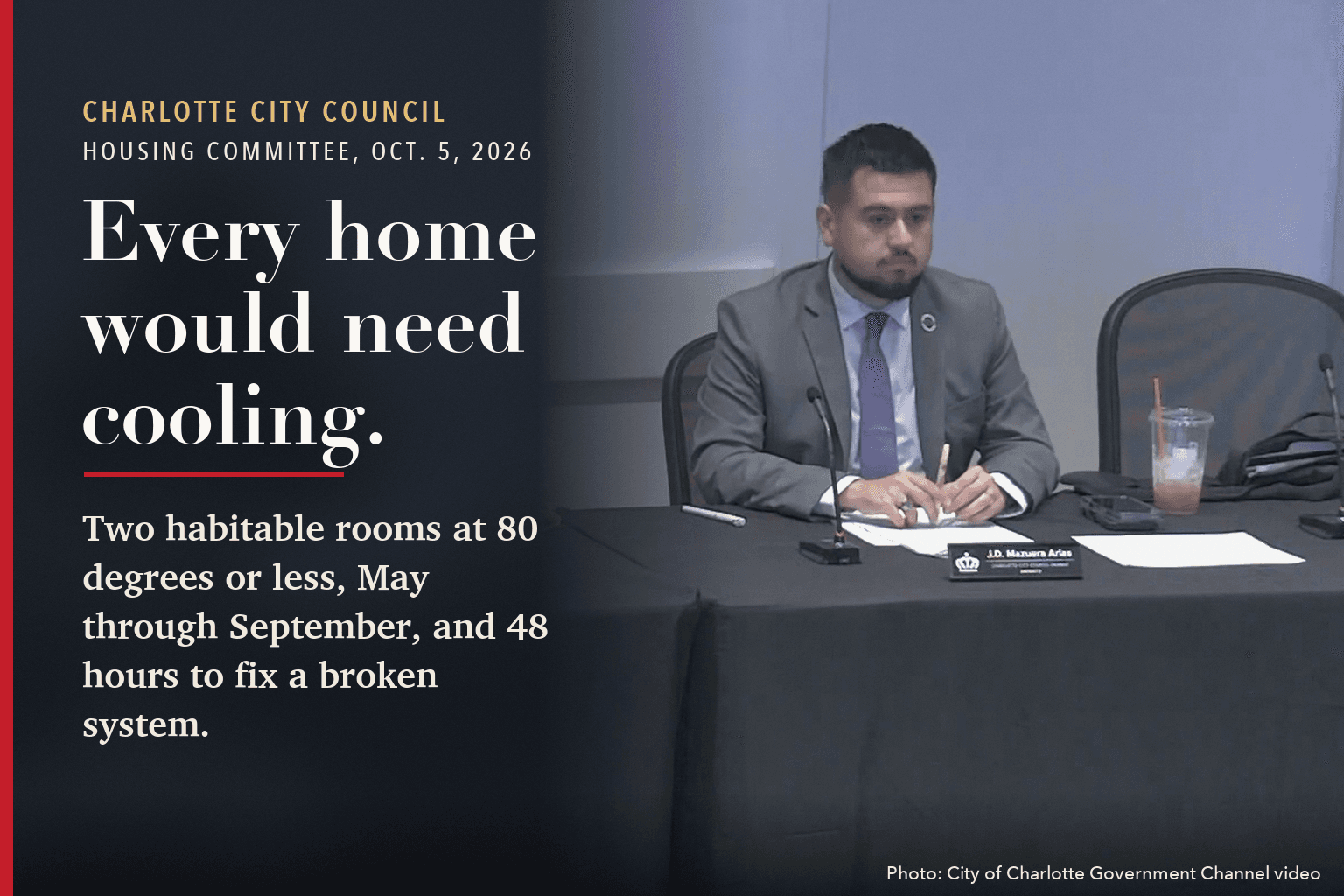
Every home in Charlotte, rented or owned, would need cooling that can keep at least two habitable rooms at 80 degrees or less from May through September, under a change to the city's minimum housing code now headed to the full City Council. Today the code requires owners only to maintain cooling equipment that is already there, according to the city's presentation.
For renters, the change would add two protections. A broken system in those months would be classed as "imminently dangerous," giving the landlord 48 hours to fix it, the same window the code gives broken heat. And the code already bars a landlord from collecting rent on an imminently dangerous home, so that ban would then cover a broken cooling system. City staff wrote that the city could not monitor or enforce the rent rule, but that it would give tenants a defense in an eviction case for unpaid rent while the cooling is out. The city's Renter's Handbook still tells tenants not to withhold rent without first talking to a lawyer, the memo says.
The council's Housing Committee voted 3-1 on Oct. 5 to send the change to the full council, on a motion by Council Member Kimberly Owens of District 6. The chair announced the count without saying how each member voted, and the committee's minutes have not been posted. No council date had been posted on the city's meeting calendar as of Oct. 29, and the item was not on the council's Oct. 12 or Oct. 26 agendas.
Owens said she was focused on the health risks, including people who cannot get restorative rest at night because of the heat. "I don't need us to await to have fatalities here during our summers among some of our most vulnerable residents before we take action," she said.
Owners are covered, too
The rule, as the city's presentation describes it, covers every residential dwelling. Tenant complaints reach the city mainly through calls to 311, the city's memo to the committee says, while code cases at homes lived in by their owners most often follow a house fire: 97 of an estimated 149 such cases in the 12 months since September 2025.
The committee chair, Council Member LaWana Mayfield, who holds an at-large seat, said the rule is aimed at landlords, not owners. Speaking of herself as a homeowner, she said, "If I choose not to run my AC, I am not in fear of code enforcement knocking on my door."
Members pressed staff on owners. Owens asked how much code enforcement work involves homes lived in by their owners; staff named a house fire as one case that brings inspectors inside an owner's home. A member asked whether an owner found without working cooling by an inspector who came for something else would be fined after two days, and whether owners who cannot afford a repair could get an exception. The chair said she saw no need to add language to the rule yet. Homeowners who qualify can apply to the city's rehab programs, including emergency repair, for cooling work, according to the memo; those programs make deferred, forgivable loans.
Who pays
The city cannot stop landlords from passing the cost on through higher rent, because state law bars it from regulating rents on private property, the memo says. Staff listed that among the rule's drawbacks, along with the chance that some owners take units off the market.
The presentation says the rule gives owners flexibility on the type of cooling equipment, and the city's cost list includes window units. Contractors gave the city these estimates, installation included: $300 to $700 for a window unit that cools one or two rooms, $9,000 to $17,000 for a mini split system that cools two or three rooms per unit, and $15,000 to $30,000 for a traditional system for the whole home. Since October 2025, the city's own rehab programs have paid a median $475 to repair a system and $9,143 to replace one where the ductwork was already in place.
"I appreciate that there are going to be costs attendant to this. I appreciate that there's going to be the potential for those to be passed on to residents," Owens said.
A city pilot program for small landlords reimburses 75 percent of eligible installation costs for permanent cooling systems in rental units that never had them, up to $10,000 a unit and $100,000 or 10 units per owner, at properties of 1 to 49 units, including single-family rentals. In return, the owner must keep the units affordable to households earning 60 percent of the area median income, and keep the system maintained, for three years. The city also gives window units to households without working cooling: about 200 so far, staff said, with a goal of 100 a year.
Inspectors mostly work weekdays
Code inspectors work roughly 8 a.m. to 5 p.m. and typically not on weekends, staff told the committee. Tenants report problems by calling 311, weekdays from 7 a.m. to 7 p.m., and are encouraged to tell the landlord first, the memo says.
If a landlord missed the 48 hours, city housing staff would weigh an immediate repair or replacement, refer the tenant to relocation services if neither worked, and move toward civil penalties, according to the presentation. A repair already scheduled, or a work order open at the first inspection, could be an exception.
The memo says the city would need a new code enforcement team of five to eight employees. Raquishela Stewart, director of the city's Housing and Neighborhood Services department, told the committee that staff would "attempt to absorb the work" because the rule runs only May through September. Council Member JD Mazuera Arias of District 5, reading from the memo, said Charlotte has grown since 2018 while code enforcement staffing has not kept pace, and asked colleagues to consider it in next year's budget.
How it got here
Then-Mayor Vi Lyles referred the question to the committee on June 30. Since earlier meetings, staff cut the repair window from 72 hours to 48 and raised the requirement from one habitable room to two, Stewart said. Owens said she wished it covered all habitable areas.
Before a council vote, the city's presentation calls for a preview for council and a public hearing, and it lists the date for all three as "date tbd."