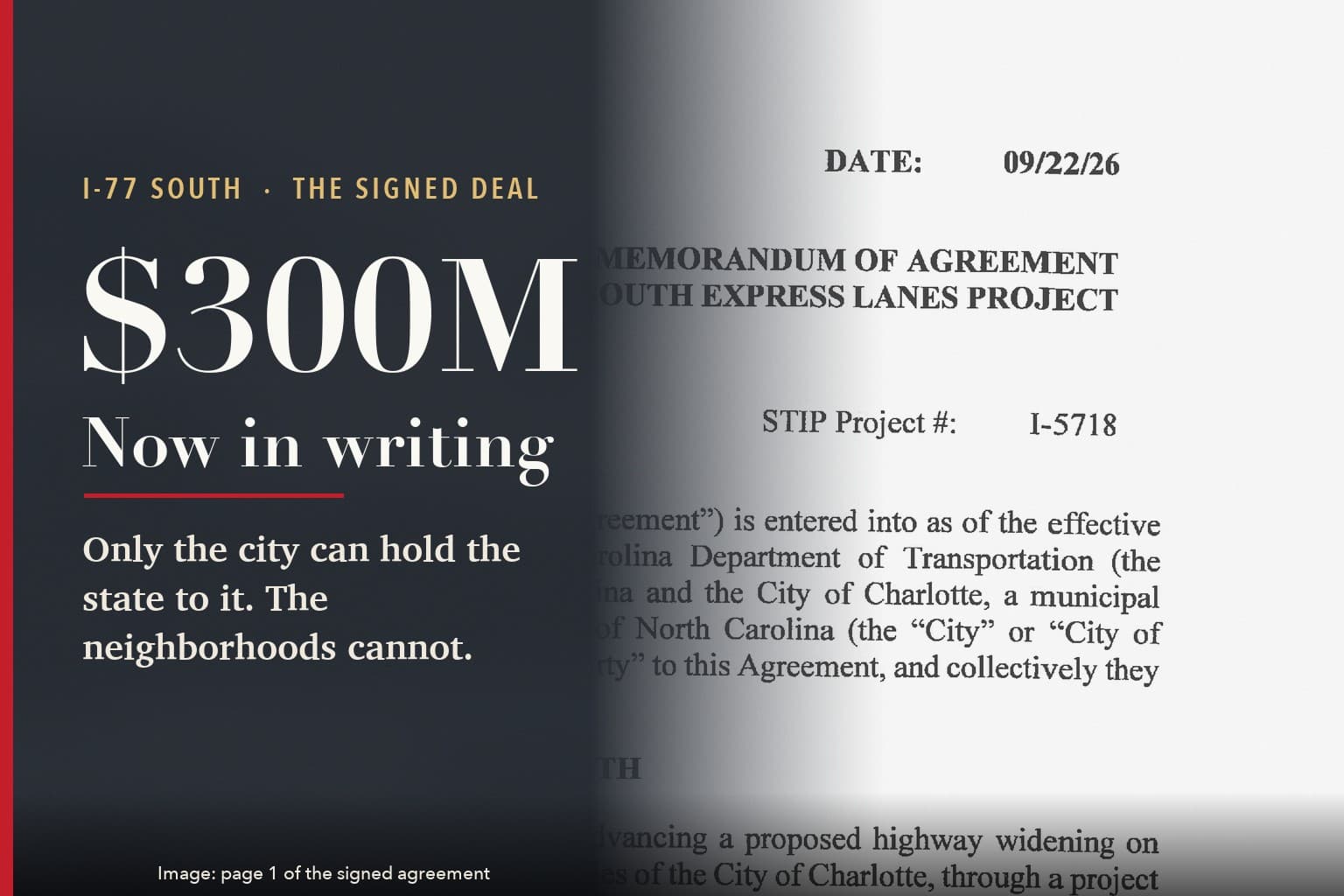
The $300 million promised to west Charlotte in exchange for the Interstate 77 South toll lanes is now in writing, in a 12-page agreement between the city and the N.C. Department of Transportation. It makes the private company that would build and run the lanes responsible for putting up the money, and it gives the neighborhoods the money is meant for no power to enforce it. Only the city can hold the state to it.
City Manager Marcus D. Jones and Transportation Secretary Daniel H. Johnson signed it between two votes. On Monday, Sept. 21, the Charlotte City Council voted 7-4 to rescind its May rejection of the project, under a state budget provision that would have made the governments opposing it repay the state's costs on the project since 2018, $69,577,547.67, unless they reversed themselves by Oct. 5. The agreement is dated Tuesday, Sept. 22. On Wednesday, the region's transportation board, the Charlotte Regional Transportation Planning Organization, voted to bring the toll lanes back. Only Matthews and Mecklenburg County voted no.
Eight days before the signing, the city's lawyer told the council no agreement existed yet. "At this time, there is no agreement or requirement by NCDOT," City Attorney Andrea Leslie-Fite said on Sept. 14, adding that the process was still evolving and that an agreement would later be drafted and signed.
The project would add two toll lanes in each direction on 11 miles of I-77 between the South Carolina line and uptown. The benefits are aimed at west side neighborhoods the highway affects. The agreement reserves the money for communities affected by "the construction, operation, and historical impacts" of the highway, and NCDOT's July 28 letter to the city, attached to the agreement, describes reconnecting West Side communities that were divided when the interstate was first built.
Where the money comes from
The agreement commits NCDOT to "a minimum of three hundred million dollars ($300,000,000) generated through the P3 procurement process." P3 is a public-private partnership, in which a private developer finances, builds and operates the lanes. The state will require that developer to include at least $300 million for the benefits in its proposal.
Everything except $150 million for "cap and stitch" work, decks built over the interstate with crossings and green space on top, would be paid "in cash at financial closing," the point at which the developer's financing is final, into a third-party escrow account that can be used only for the benefits. The cap and stitch work the developer would build itself, as the agreement is now written.
The agreement does not say how the developer would raise the money. It says it does not obligate public money except where it spells that out, and it names no source for the $300 million other than the developer.
Separately, NCDOT must provide at least $100 million in additional transportation money for projects in Mecklenburg County, chosen in consultation with the regional board.
What the $300 million covers
A preliminary plan attached to the agreement sets a minimum for each category. The highway decks get a flat $150 million. Every other minimum is a dollar figure or a percentage "of the community benefits," whichever is greater:
- $150 million for the cap and stitch decks over the highway.
- $50 million, or 33 percent, for a regional recreation center in the southwest corridor, with Steele Creek and Nations Ford named as examples.
- $35 million, or 23 percent, for programs on housing stability, small business and economic mobility.
- $20 million, or 13 percent, for neighborhood stability, affordability and quality of life, including a civic center or similar facility in the corridor.
- $15 million, or 10 percent, for environmental improvements.
- $10 million, or 7 percent, each for facilities to address food insecurity on three corridors: West Trade Street and Beatties Ford Road, West Boulevard, and Statesville Avenue. The Statesville Avenue money also covers health and wellness.
The dollar minimums add up to $300 million. The agreement does not say what the percentages are percentages of. They add up to 100 percent without the $150 million for the decks, so they cannot all be shares of the full amount.
Who can enforce it
The agreement describes itself as binding and enforceable under North Carolina law, and it gives the city several tools. Disputes go to Mecklenburg County Superior Court, where either side can ask a judge to order the other to perform. NCDOT cannot drop or change a commitment without the city's written approval. The final contract with the developer must include performance measures and remedies for failing to deliver. And the city's support for the project is conditioned on NCDOT doing its part on time.
That said, only the two signers can use them. The agreement "does not create any rights or remedies enforceable by any person or entity, not a Party to this Agreement." The parties are the city and NCDOT. Mecklenburg County is not one. Neither are the neighborhoods.
"I don't think that this Community Benefits Agreement is airtight," Commissioner Leigh Altman, vice chair of the Mecklenburg County Board of Commissioners, told WCCB. "I can see a way out if it becomes inconvenient or difficult for DOT."
Community leaders do get a role short of a courtroom. A working group of NCDOT and city representatives and community leaders will meet at least monthly until the final plan is set, then at least quarterly. NCDOT will send the city written progress reports at least every quarter through design and construction, and it will reopen its community engagement center for the project.
The deadlines
NCDOT must give the city a proposed plan at least 45 days before it releases its final request for proposals to developers. If the two sides never agree on a final plan, the preliminary plan becomes the final one automatically the day that request goes out. After that, the plan cannot be materially changed without the city's written consent.
The agreement puts no date on that final request. The one deadline with a calendar date is Jan. 1, 2027. By then, NCDOT must release its next major bidding document for developers with these commitments written in.