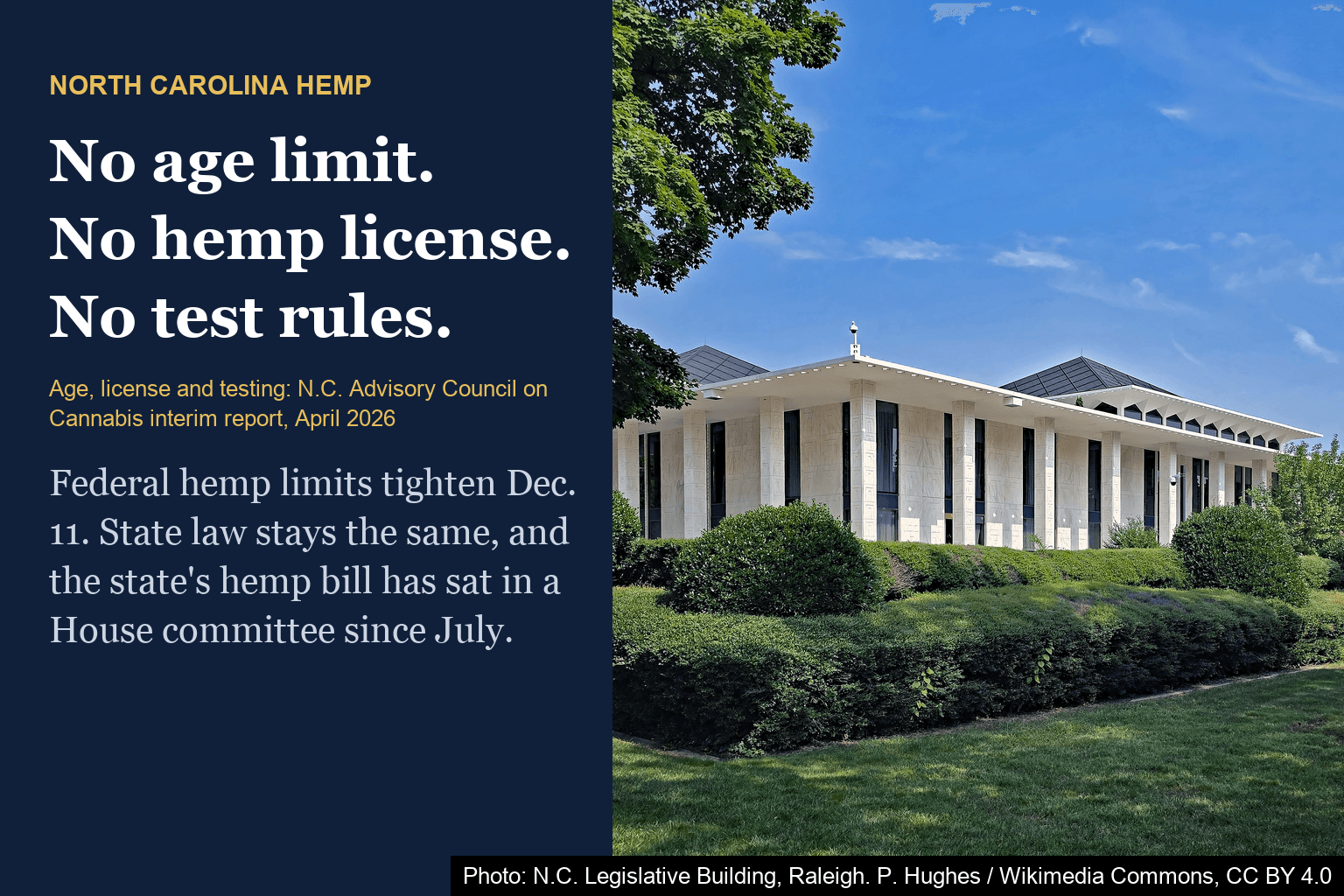
Federal law is set to stop treating many intoxicating hemp products as hemp on Friday, Dec. 11. North Carolina's law does not change that day. The governor's cannabis advisory council said in its April report that the state has no minimum age to buy those products, requires no special license to sell them and requires no testing of what is in them.
The North Carolina Advisory Council on Cannabis, which Gov. Josh Stein created to recommend how the state should handle cannabis, put the problem bluntly in that interim report. The state's intoxicating cannabis market, it said, "exists in a dangerous policy gap that is neither true prohibition nor meaningful regulation."
A $1 billion market with few rules
The report cites estimates that put the state's intoxicating hemp industry at about $1 billion. The council's market subcommittee, in its Oct. 23 minutes, put the number of retail locations at roughly 23,000, possibly 30,000 or more.
The report says the rate of emergency department visits in North Carolina for intoxicating cannabis ingestion rose more than 600 percent in recent years among children 17 and under, and more than 1,000 percent among older teens. Those figures cover intoxicating cannabis generally, not hemp products alone.
Two definitions of hemp
The federal change is Section 781 of a spending law Congress enacted on Nov. 12, 2025. It measures hemp by total THC, counting every form of THC, including tetrahydrocannabinolic acid, or THCA, rather than delta-9 THC alone, and it keeps the limit at 0.3 percent by dry weight. It excludes from hemp any finished product with more than 0.4 milligrams per container of THC and similar cannabinoids combined. It also excludes products made with cannabinoids the plant cannot produce naturally, or with cannabinoids made outside the plant.
The section took effect Nov. 12, 2026, but only for products made with cannabinoids the plant cannot produce. A stopgap spending law signed Sept. 2, 2026, holds off the rest until Dec. 11.
Section 781 sets no penalties of its own. It changes what counts as hemp, and the council's report says that change "brings many existing hemp-derived intoxicating products back under federal controlled substance regulation." None of the documents says who will enforce the federal change in North Carolina stores, or how.
North Carolina wrote its own definition into its drug laws. State law defines hemp by delta-9 THC alone, at no more than 0.3 percent by dry weight, and says marijuana "does not include hemp or hemp products." The state definition does not refer to the federal one, and the change in Washington leaves its words as they are.
The state's own test
In testing by the state's Alcohol Law Enforcement Division, more than 90 percent of samples exceeded the 0.3 percent delta-9 level in the state definition, according to the subcommittee's Oct. 16 minutes, which give no sample count, product types or follow-up.
The interim report says the state has not established a prohibition framework "that provides law enforcement with the appropriate oversight and enforcement authority."
Who would enforce a change
The report says an effective ban would take comprehensive action from the General Assembly. A prohibition of cannabis "would require statutory language banning cannabis and creating legal authority, financial resources, and enforcement tools for law enforcement to respond to a newly prohibited market," it says. With a "wild west" hemp market on top of a robust illicit marijuana market, it says, "law enforcement would need significant support."
The bill that stalled
The General Assembly has a hemp bill. House Bill 328, titled "Regulate Hemp-Derived Consumables," passed the Senate in a compromise version, 37 to 6, on July 2. The compromise was presented in the House on July 30 and sent to the House Rules Committee, where it has stayed.
The House changes hands in January. Democrats won a majority there in unofficial results this month and have named a new leadership team for the session.
What the council wants
The council wants the state to regulate THC the same way wherever it comes from. Its interim report recommends "a unified approach that regulates products based on total tetrahydrocannabinol (THC) content and intoxicating potential, rather than creating separate regulatory structures for hemp and marijuana." Its market subcommittee has been weighing state-run marijuana stores.
The subcommittee's Oct. 23 minutes say bringing the hemp market under control "was called the single most important recommendation." A limited market is preferred, the minutes say, and "sellers operating outside the law should not be rewarded with easy entry into a regulated market."
The full council meets Tuesday, Dec. 15, at 1:30 p.m. at the state Department of Health and Human Services headquarters in Raleigh, where the subcommittee's timeline calls for a vote on the final report. Stein's executive order gives the council until Dec. 31 to send Stein its final recommendations.
The Oct. 23 minutes also list a possible short-term step that would not wait for any stores: "enact robust regulations and statutes (labeling, packaging, age limits) before building any sales system."