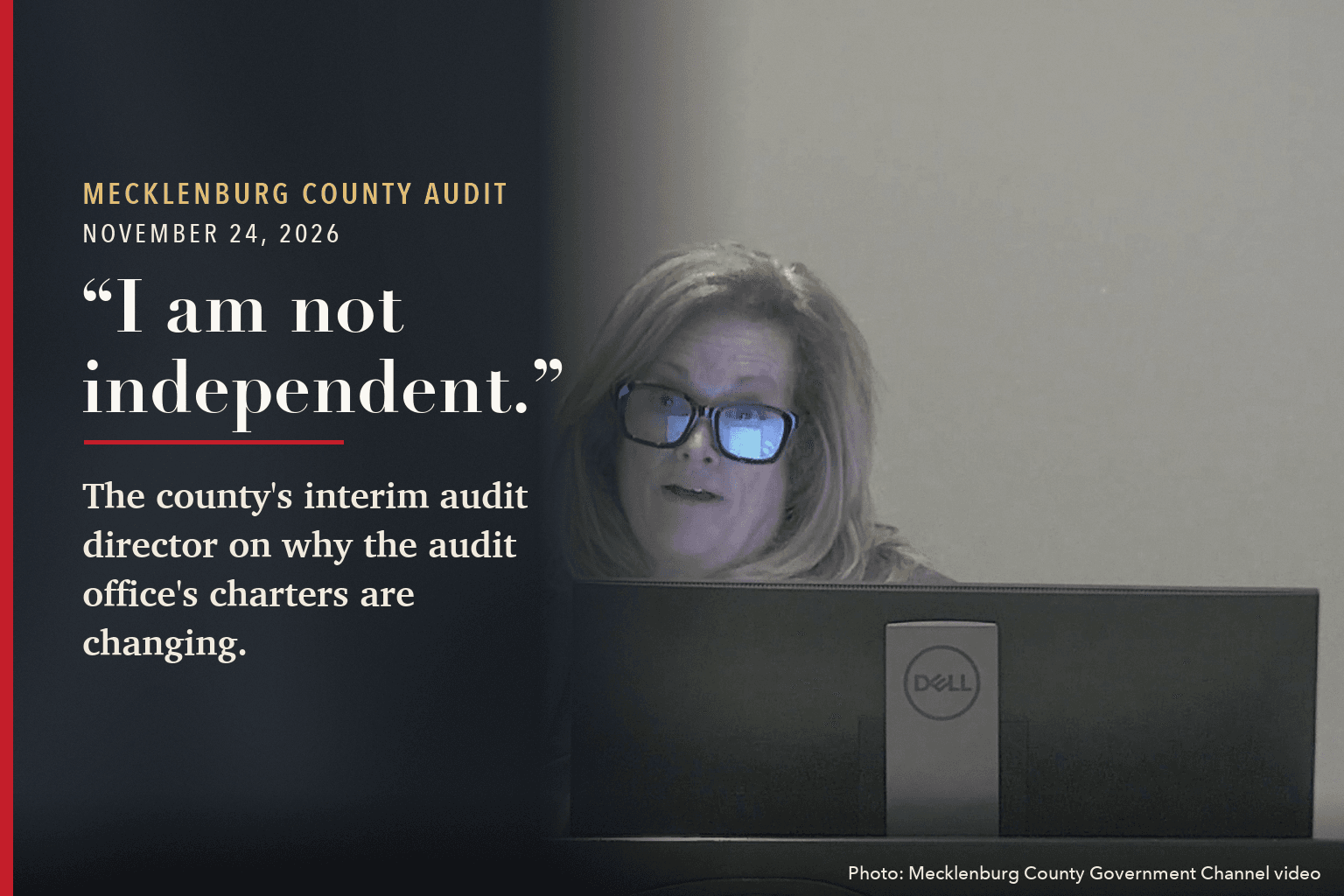
Mecklenburg County's internal audit office has not started a new audit since its current interim director took over, and the deputy county manager now running it told commissioners Tuesday that in the role, she is not independent.
“Me being in this role, I am not independent,” Deputy County Manager Michelle Attreed, who is also the county's interim internal audit director, told commissioners at Tuesday's budget and policy session. Attreed oversees finance and technology, two areas the audit office examines. “Those are areas that get audited, right?” Attreed said. “So I can't issue an opinion as an independent internal auditor.”
The county's answer is a pair of updated charters, the documents that set the office's mandate and the rules for the board committee that oversees it. They would have the office answer to the board's Audit Review Committee for its audit work and to the county manager for administration. Attreed said the charters were to return Dec. 1 on the consent agenda, the batch of items the board passes in one vote. Commissioner Yvette Townsend-Ingram said Tuesday that Townsend-Ingram will pull the charters from that list. “I will be pulling this before it goes for consent for approval to the whole board,” Townsend-Ingram said.
Why the office is changing
Attreed said the pause on new audits was deliberate. Staff have spent the time closing out old audits, updating policies and working toward the Global Internal Audit Standards, the profession's rulebook, which were issued in 2024 and took effect in January 2025. After taking the interim role, Attreed said, a gap assessment showed the office had not yet implemented them. Asked near the end of the meeting whether the county had been in compliance, Attreed said it was in compliance with the previous standards but not the new ones.
The documents governing the office are older than the standards. The Audit Review Committee charter was last adopted by the full board in December 2018 and the internal audit charter in February 2017. The committee amended both in 2021, Attreed said, but neither version went to the full board.
In Attreed's comparison of North Carolina governments, Mecklenburg's audit office has a budget of about $2.8 million and 16 positions, for a county budget of $2.6 billion. Wake County's has $1.7 million and eight positions and reports to a deputy county manager. Durham and Guilford, Attreed said, have the two-way reporting Mecklenburg is proposing.
What the charters would do
The office would report on its audit work to the Audit Review Committee and on day-to-day matters, such as budget, staffing and routine approvals, to the county manager. The director would report at least quarterly to the board through the committee and the county manager.
The committee would also get a say in who runs the office. Under the old charter, Attreed said, the committee was to be “apprised” by county executive management. Under the new one, the committee would review the manager's request for proposals or recommendation on any appointment, reassignment, replacement or dismissal of the internal audit director or an outside firm providing audit services. The charters also add an annual review of the audit budget, and the internal auditors would meet at least four times a year to discuss the county's audits.
Attreed said both drafts were shared with committee members and reviewed with a consultant from the Institute of Internal Auditors. The committee's chair, Commissioner Laura Meier, was absent Tuesday. Attreed said Meier directed that the changes be brought to the board Tuesday for discussion, so they could then be adopted by consent Dec. 1.
The objection
Townsend-Ingram said the committee did not choose the template for the charters and was not given a final side-by-side review of the old and new versions. Attreed said only one template exists for public-sector bodies, so that was the one used, and that the redlined changes were sent to the full committee. Townsend-Ingram's, Attreed said, were the only edits returned.
Near the end of the meeting, Commissioner Elaine Powell said, “I couldn't believe that the auditor was staff.”
Also on Tuesday's agenda
Requests to staff. A new Commissioner Response System goes live in January, with a nine-question online form for commissioners' requests. Every request copies the county manager, and a deputy county manager approves each response before it goes out. A staff presenter said the governing policy dates to 2001 and has not been updated. The proposed version limits staff to four hours on a request within current county services. Anything longer, or outside current services, would need a majority vote at a meeting of the full board before the manager assigns staff. Asked about marking requests confidential, a county official told commissioners the system has no such option because that cannot be done legally and requests are public information. The policy changes are to be formally adopted at a later date, and no date was given.
Opioid settlement money. Marcus Boyd, the county's opioid settlement program manager, presented Public Health's $8.632 million plan for fiscal 2028 and 2029, spread over 11 strategies and drawn from money the board already authorized and has not spent. The county is scheduled to receive about $77.4 million from 2022 through fiscal 2039, and $13.09 million has been spent so far. Boyd said the money the county has already formally recognized for use “can carry these programs all the way through FY29,” and that “we don't need to recognize a single new settlement payment to do it.” Bidding for the new contracts is scheduled to open Dec. 3, with proposals due Jan. 2 at 4 p.m. and contracts starting July 1, 2027. The revised spending resolution and a new full-time health program supervisor position are slated to come to the board Dec. 1 on the consent agenda, with no presentation.