On Oct. 13, a Mecklenburg County commission committee set out to check whether Discovery Place, the nonprofit that runs the city's science museum, could take on more debt. It told staff to have the county's financial advisor draft a proposal for the review. Discovery Place owed the county $14.6 million for the new nature museum in Freedom Park and had said it could not pay it in a lump sum.
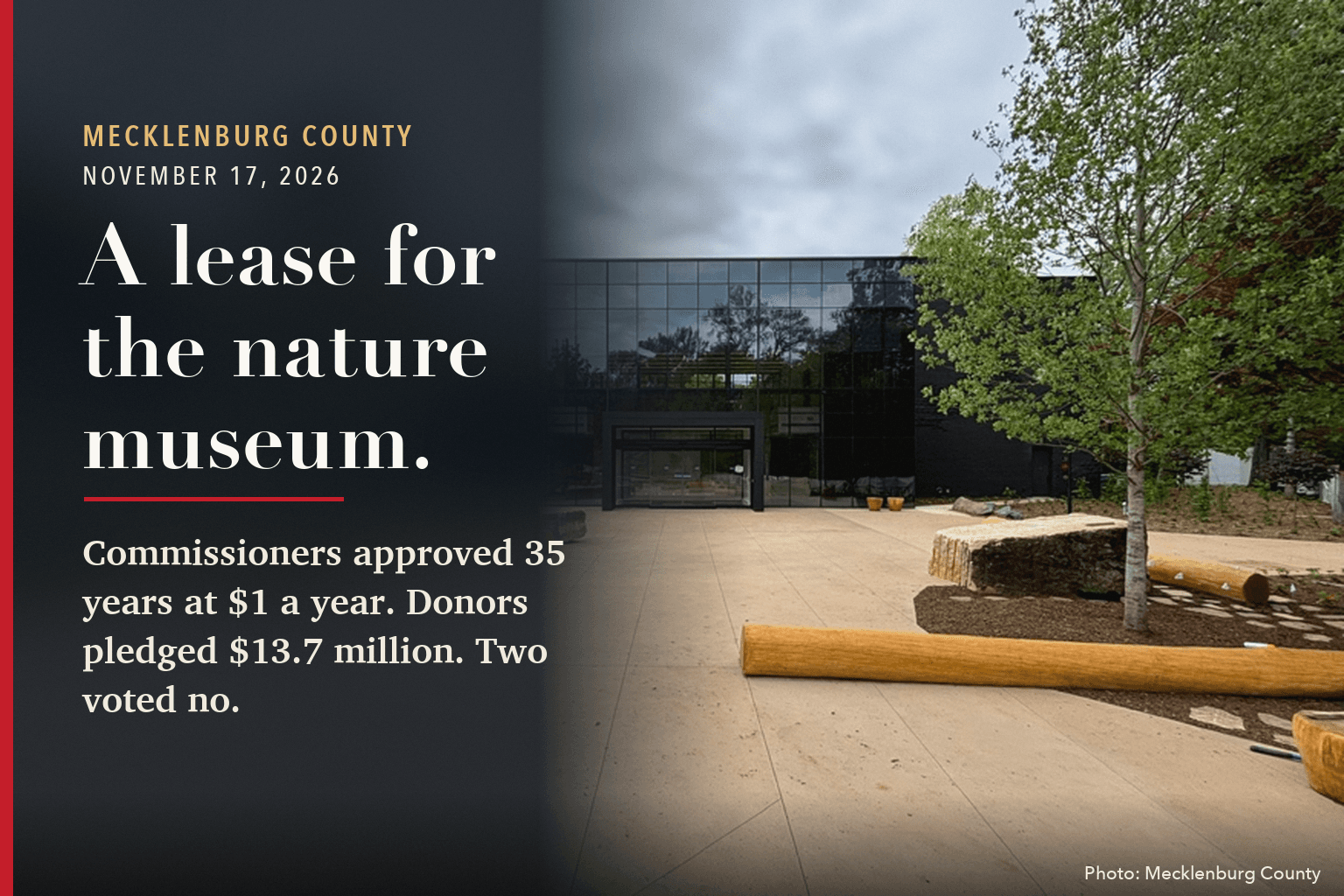
The review was not done. On Tuesday, Nov. 17, commissioners approved the deal anyway: a 35-year lease of the museum to Discovery Place for $1 a year, and a plan to repay the debt over five years with money pledged by donors the county did not name until the next day.
"I still have a problem with the fact that a financial review was not done and won't be done," Commissioner Yvette Townsend-Ingram, who serves at large, said before the vote. "If we can't find $30,000, which is what the review costs to determine the financial health of an organization, then we have no business loaning $14.7 million."
"Why would we not do a financial review?" she asked. No one answered that question.
The board took three votes on the deal, and each passed with two commissioners against. Elaine Powell of District 1 voted no on the lease. Townsend-Ingram said she could not support the deal without answers to her questions.
How the county got here
The museum was supposed to be a simpler arrangement. Under a 2019 agreement, the county would design and build it and pay up to $16 million. Discovery Place would pay for the exhibits and anything the building cost beyond that.
The building's cost rose to $36 million. In December 2023, Discovery Place asked the county for $20 million more and said it could not get construction loans. Commissioners gave it $10 million. The county covered another $14.7 million of the construction contract, and Discovery Place signed a letter agreeing to pay that back, according to a county staff briefing in October.
The money was due Oct. 27, six months after the building was finished. In July, Discovery Place told the county it could not pay in a lump sum. In August it offered instead to add a $2 contribution to its admission tickets, give that money to the county and call the debt "satisfied in full and extinguished." It valued what it brings to the partnership, from running the museum to its programs, at more than $100 million over 30 years.
County staff said no. In October they laid out the alternatives, including the county taking over the museum itself, which Park and Recreation estimated would cost $3 million to $4 million in its first year. Staff recommended a minimum payment of $400,000 a year. At that rate, the briefing said, the debt would take about 36.5 years to repay.
Then the board's ad hoc committee on Discovery Place met Oct. 13. County Manager Mike Bryant told commissioners at the end of that day's board meeting that the committee had directed staff to have the county's financial advisor draft a proposal to assess how much debt Discovery Place could take on, so the county would not rely only on the nonprofit's own figures.
No review came back. The plan the board approved pays the full amount in five annual payments "because of the generosity of our philanthropic and corporate community partners," Bryant said Tuesday.
What the county gets, and what it risks
Credits and construction savings brought the debt to $13.7 million. The first payment is due within 14 days after the agreements are signed, said Mark Hahn, the county's asset and facility management director.
The county's agreements are with Discovery Place, not with the donors. When Townsend-Ingram asked whether the county was signing with the donors or with Discovery Place, Hahn said every agreement is with Discovery Place. If it stopped paying, he said, the county would face the same choices again: find another donor, set up a repayment plan or take over the museum.
"We'd be right back there again," he said.
The county has other large bills in view. Commissioners have been told a federal food-aid penalty could cost up to $42 million a year and that a Jail North expansion would cost more than $5 million a year.
If a payment is missed and not made within three business days of a written notice, the whole balance comes due and the county can end the lease and take back the building. It would then owe Discovery Place the cost of the exhibits, which staff put at about $12.8 million in October, less what is still owed. Discovery Place must also hand over financial records within 30 days of a written request.
On Wednesday the county named the donors: Julie and Howard Levine, The Leon Levine Foundation, Bank of America, the C. D. Spangler Foundation, the Philip L. Van Every Foundation, Discovery Place's Board of Trustees and one anonymous donor. It gave no amount for any of them. The building will be called the Mecklenburg County Piedmont Museum of Nature, Julie and Howard Levine Campus.
Thirty-five years
Arthur Griffin, who serves at large, voted for the deal but said he would have preferred a lease renewable every 10 years. "It just seems like we could have gotten a better deal," he said of a donor's name staying on the building for 35 years, though he added that the county got the best deal it could at the time. Hahn said donors who give millions expect a long lease.
Powell, whose term ends Dec. 2, said the county has "to be smarter on our contracts and leases when we're doing this with nonprofits so that we have a way out if the partnership goes sour."
The city's half of the question
Discovery Place's main museum, uptown, belongs to the City of Charlotte, and the city is deciding what to do with it. It opened in 1981 and had its last major renovation in 2011, city staff told the City Council in March. The city has hired consultants to weigh keeping it, moving it or redeveloping the site for mixed use, with an aquarium elsewhere among the ideas.
At that March session, one council member asked whether Discovery Place still owed the county for a project it had not finished. The staff presenter answered, "I believe so," and said the question might need a "phone a friend." In August, Council Member Kimberly Owens told a council committee about "changes of leadership that we're anticipating" at Discovery Place, and asked for an update on a possible split of an aquarium from the science museum before "any additional dollars are put into" the building.
When it opens
Hahn said the documents should be signed within a couple of weeks. The county says the museum will open in spring 2027, with a treetop canopy walk and trails, which Discovery Place is paying for, to follow later in the year.
Laura Meier, whose District 5 includes the park, said she thought the 2016-2017 board first voted on the project. "So it's going to take 10 years before this thing opens," she said.
"This plane has landed," Chair Mark Jerrell said after the last vote.