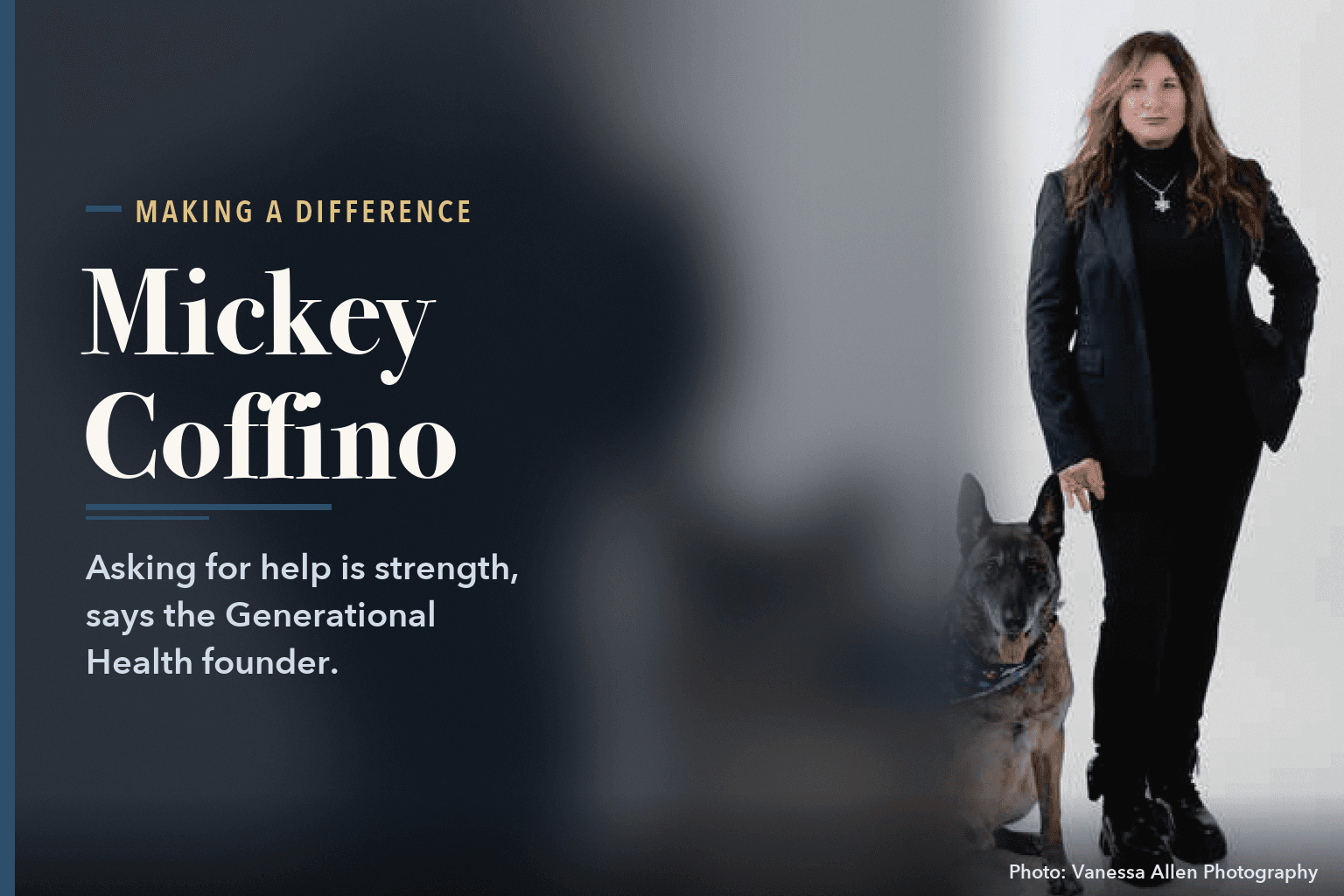
Michelle "Mickey" Coffino, founder and CEO of Generational Health and founder of Queen City Metal Recycling & Salvage, which advertises in Stroll Dilworth, wrote this piece for the magazine in her own words.
Every community has stories it never hears, Mickey Coffino writes: the student smiling through anxiety, the veteran carrying invisible wounds, the executive quietly battling depression, the overwhelmed parent, the neighbor struggling with addiction. "Mental health doesn't discriminate," she writes. "It affects our children, parents, teachers, first responders, Veterans and business owners. And sometimes, ourselves."
For generations, she writes, people have been taught to hide their struggles, push through and keep going. "But true strength isn't pretending everything is okay. It's having the courage to say, 'I need help.'"
That belief is why she founded Generational Health: to create a different conversation about mental health, one built on compassion instead of stigma, connection instead of isolation and prevention instead of crisis.
What Generational Health does
Generational Health was created to make mental health care more accessible, personal and human. It brings together licensed clinicians, psychiatry, peer support specialists, technology and an AI companion that complies with HIPAA, the federal law that protects the privacy of health information. The aim, Coffino writes, is to ensure that no one has to face life's hardest moments alone.
It started at a scrapyard
The mission began more than a decade ago with Queen City Metal Recycling & Salvage and its nonprofit Second Chance Program. What many people know as a recycling company became, in her words, "a place where individuals facing mental illness, addiction, homelessness, incarceration and other hardships could find opportunity, dignity and hope."
Through that work, Coffino writes, she learned that people rarely need someone to rescue them. They need someone willing to believe in them. She has watched people rebuild careers, restore relationships, reconnect with their children and rediscover purpose.
But employment alone was not enough. People needed access to compassionate mental health care before they reached a crisis. That realization, she writes, became the foundation for Generational Health.
The message
Her vision is a future where asking for help is seen as courage, every child knows they matter, every veteran knows they are not forgotten and every person, regardless of their past, has the chance to write a better next chapter.
"If there is one message I hope readers carry with them, it is this: No one is beyond hope. Everyone deserves dignity, compassion and a second chance," she writes. "Together, we can build communities where hope is stronger than stigma, healing is possible and no one has to face life's journey alone."
This story appears in the September 2026 issue of Stroll Dilworth.