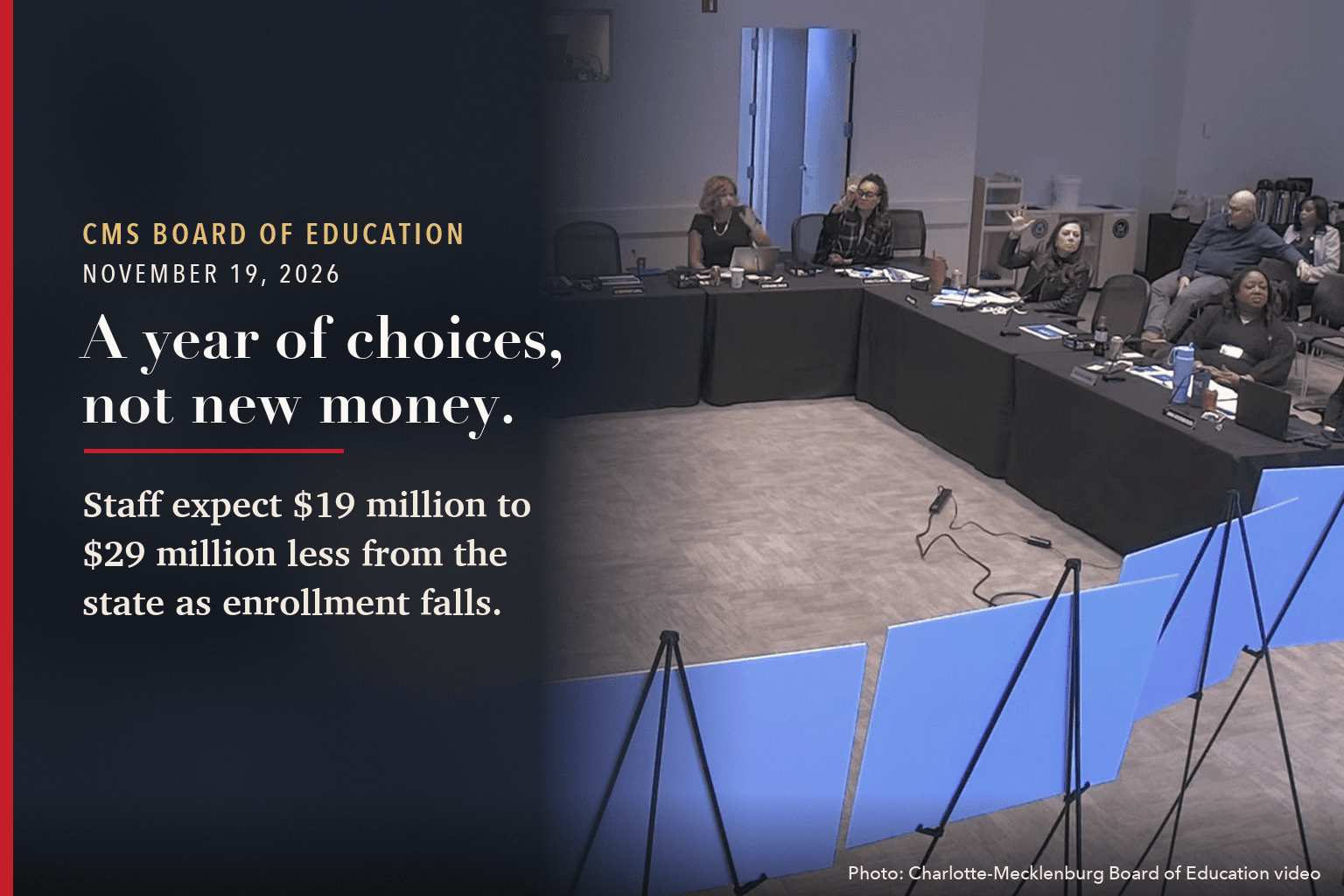
Charlotte-Mecklenburg Schools has lost 5,596 students in two years, and its state money is expected to shrink with them. District staff told the school board Thursday to expect $19 million to $29 million less from the state next year and about 202 fewer state-paid teacher positions. They are building next year's budget for cuts.
"This is a year of choices, not new money," said Beth Thompson, the district's chief of strategy and innovation, who presented at the first budget work session of the Charlotte-Mecklenburg Board of Education. Staff are planning for cuts on purpose, she said. "That's a plan. We're not in crisis." Because staff saw the drop coming, she said, "we can make these choices deliberately."
The pressure comes from two directions. State money follows enrollment, and enrollment is falling. The county pays for much of what the state does not, and on Nov. 3 voters approved a constitutional amendment requiring the legislature to limit local property tax increases. "Property taxes are the county's largest source of school funding," Thompson said. The legislature has not written the limit yet.
No money was decided at Thursday's work session. The board is to vote on a budget April 27.
Fewer students, and where they went
CMS had about 141,000 to 142,000 students for three years. Enrollment fell 1.7 percent last year, to 139,476, and the district's own count this fall is 136,298, down another 2.3 percent. The state has not yet made that count official. State money for 2027-28 follows it, and staff estimate the state will fund about 3,200 fewer students than this year. Last spring, the 1.7 percent drop cost the district more than $10 million in its state planning allotment.
A demographic forecast expects most of the decline to be over by next year, with a further drop of about 0.4 percent, then growth. The change is uneven. Over five years the forecast has the west and southwest growing about 6 percent and the northeast shrinking about 3.5 percent, mostly in middle and high schools. Thompson named "right-sizing in the northeast and central high schools" among the problems ahead, along with boundaries and building use in the south of the county. She said more would come in December and January.
Some of the students went to charter schools. Last year 26,285 Mecklenburg students attended charters, Thompson said, 15.9 percent of CMS and charter enrollment combined, compared with 10.1 percent statewide. CMS's local per-student money follows each of them: $100.4 million of the county's money passes straight through to charters. Acting Superintendent Melissa Balknight told the board that figure will rise, and that a large number of CMS families now use Opportunity Scholarships, the state's private school tuition grants, which are now open to families at every income.
CMS loses the most students in middle and high school. "The transition years are the toughest," Thompson said, when a board member asked whether that meant sixth grade.
What the county pays for
About 55 percent of the CMS budget comes from the state, 7 percent from the federal government and about 36 percent, or $699 million, from Mecklenburg County. Salaries and benefits are 78 percent of the whole. When the county raised its contribution last year, Thompson said, the new money went to raises, benefits, charter payments and other operating costs, none of it to new programs, and CMS still had to cut $6.6 million.
The state pays for students by formula. It pays for a share of students identified as gifted, a capped share of students with disabilities, and English learners on a three-year average that runs a year or two behind the children. "The state funds a number, but not what they need," Thompson said. The county pays the rest, and it pays for staff the state does not: extra assistant principals and counselors, a media coordinator in every school, and a literacy and math master teacher in every school. Each locally paid teacher costs about $79,000 before the local supplement.
When enrollment falls, the state pays for fewer positions. If CMS keeps its own staffing standards anyway, Thompson said, it takes more county money every year.
What staff want protected
Thompson said the budget is meant to protect the district's gains. The number of low-performing schools fell from 58 to 27 in three years, she said; third grade reading rose 11 points last year and college and career readiness in high school Math 1 rose 13.
But the district is behind on its own targets. Of the board's four goals, only one, the share of graduates enrolled, enlisted or employed, beat this year's target. The other three rose but missed, and at the current pace, Thompson said, none of them will reach its 2029 goal. Asked by a board member, she said she believes goals one and three can still get there. Goal two is furthest behind. Most of the students behind, she said, are "exceptional children, multilingual learners, and children of color." Exceptional children is the state's term for students in special education; multilingual learners are students still learning English.
Many of those students attend schools that get no supplemental federal money, which follows "poverty, not need," Thompson said. On the board's second goal alone, she said, about 14,000 students who are off track, 37 percent of them, attend schools that get none of it. Board member Charlitta Hatch asked whether staff were looking at funding schools by what their students need, an approach she called weighted student staffing. Thompson said she was laying out facts before recommending anything.
What could be cut
Principals and central office departments answered the same anonymous survey this month. Asked on Nov. 5 what to protect, principals named people: about 60 of 97 answers named master teachers or teacher-leader roles. "Their phrase was people over platforms," Thompson said. Their top unfunded need was more help for students in special education, named about 27 times.
Asked what to scale back, about 46 of 98 principals' answers named central office and performance area specialist jobs that do not work in schools. About 31 named OnFlow, the district's public communication platform, formerly called Let's Talk, and others named i-Ready.
When central office departments answered on Nov. 12, the most common answer on cuts, about 18 of 56, was "there's nothing left to cut." The largest saving any department offered was dropping the old Lawson payroll license, about $608,000 a year, which cannot happen until the new Oracle system goes live in January 2028. Others named duplicate digital platforms, events and food, out-of-state training and travel, and printing. Thompson warned that some offered cuts only move the bill: "if cutting that thing shifts the cost to schools, it's not really a cut."
What comes next
Members agreed, by holding up a fist or one to five fingers, on three principles: the board's goals and guardrails come first and are paid for first; schools get help with the measures behind their state letter grades; and extra support follows the students who need it.
Members and staff had also marked their priorities among 22 budget topics on posters. Teacher and staff recruitment drew the most marks, followed by the achievement gap and safety and discipline on school buses. A proposal for staff to brief the board on all 22 drew no consensus. Members then agreed on the top 11, half the list. Board member Shamaiye Haynes had warned that a shortened list could shut out a member whose topics missed it, which, Haynes said, "represents a little bit of an equity issue." Staff agreed to meet one on one with any member about a topic left off.
Staff are to bring costs for the top topics to the next work session, Thursday, Dec. 10, at 5 p.m. Under the calendar Thompson presented, the board is to vote on its budget priorities Jan. 26, hold a public hearing April 13 and vote on the budget April 27. The board also tentatively set a joint meeting with the county commissioners, a board with three new members, for Thursday, Jan. 14.
The district will build that budget without its chief financial officer. Kelly Kluttz retires Dec. 31, and an outside firm, HIL Group, is to provide financial management and budget development support. The board has not hired a successor to Crystal Hill, the superintendent it fired in September; its search is underway. Last spring the board rejected Hill's first budget 8-1 before approving an amended one.