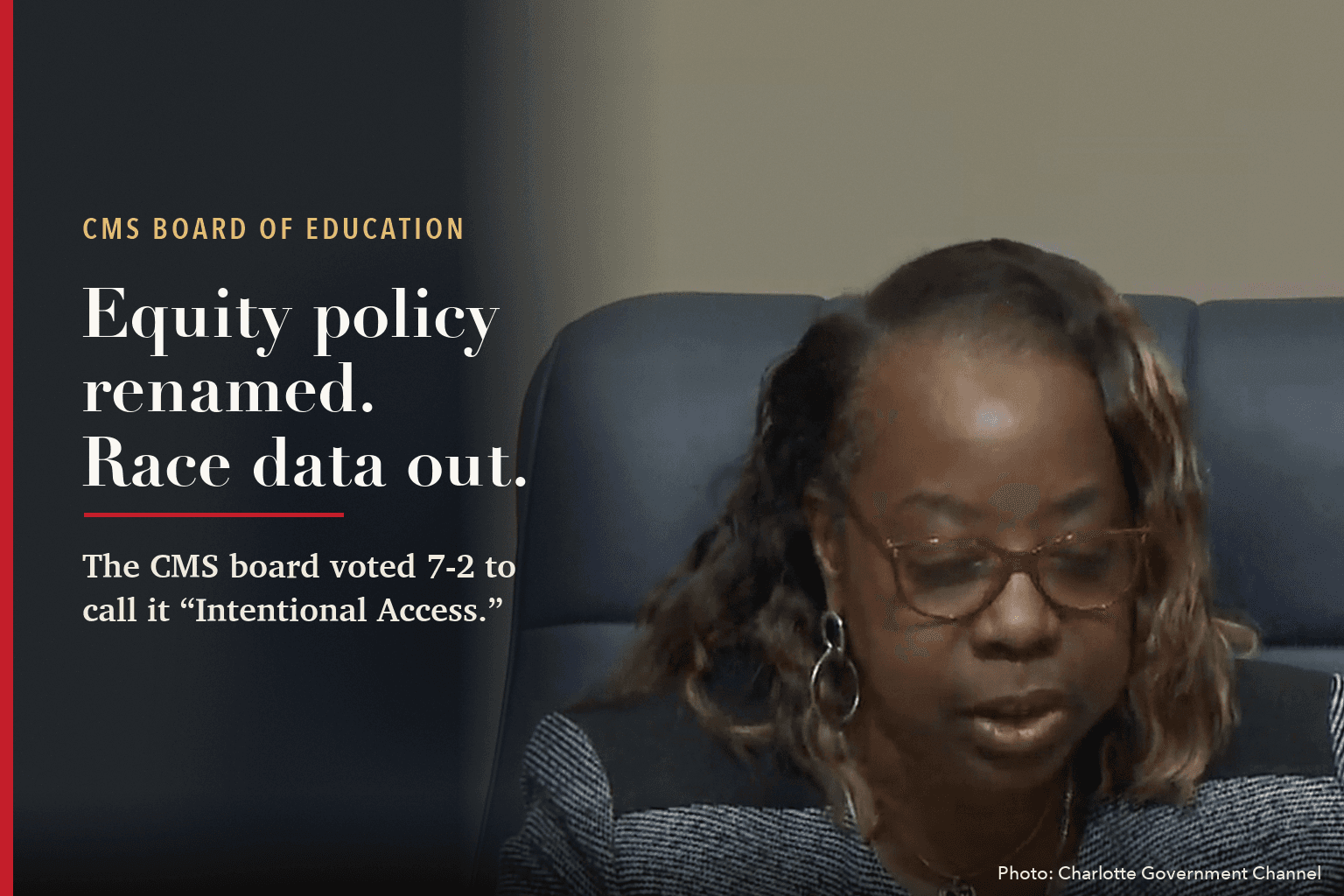
The Charlotte-Mecklenburg Board of Education voted 7-2 on Tuesday to rename its equity policy "Intentional Access." The new version no longer requires the district to break its data down by race.
The policy calls for a yearly report on how students are doing. Three lines in the old version told the district to sort that report's data by race. All three now leave race out; the main one now lists socioeconomic status "and any other data that illustrates opportunity gaps." A line asking for "efforts used to reduce racial disproportionality in suspensions" now asks for efforts to reduce suspensions. Most uses of the word "equity" are gone, too.
Board member Lenora Shipp's motion, made for the board's policy committee, described two changes: the new title, and the removal of "references to equity as required by North Carolina Session Law 2026-41." No one at the dais mentioned the race data before the vote.
"This makes me wanna throw up in my mouth," Vice Chair Liz Monterrey Duvall said before the vote. "I'm being forced to vote on this and approve it, if not we get sued." She said she hoped "you all vote in the midterm election."
Board Chair Dee Rankin counted seven hands in favor and two opposed. He did not say who the two were.
What the law says
Session Law 2026-41 is the state budget, which Gov. Josh Stein approved July 7. On public school diversity rules, it does one thing: it moves a reporting deadline in an earlier law, Session Law 2026-20.
Session Law 2026-20 became law June 24, when the legislature overrode Stein's veto. It bars what it calls "public school units" from "discriminatory practices," from teaching "divisive concepts," such as that one race or sex is inherently superior to another, and from keeping an office "referred to as or named diversity, equity, and inclusion." Each must certify to the state by Sept. 1 each year that it complies. The law does not mention the titles of school board policies.
Last month the board cited the same budget law when it removed references to minority- and women-owned businesses from its purchasing policy. That law does abolish the state's Office for Historically Underutilized Businesses and its minority-business advisory committees. Monterrey Duvall, who made the September motion, said then that she "actually voted against this motion because it goes against my values as a woman and a minority," and would put it forward "to avoid a lawsuit."
What stayed
The policy's purpose statement still commits the board to "breaking the historic and continuing predictive links among student socio-economics status, race, and ethnicity to educational opportunities and achievement." Its community panel is now the Community Opportunity & Access Committee, and its members are still expected to be "community advocates for equity."
Related coverage