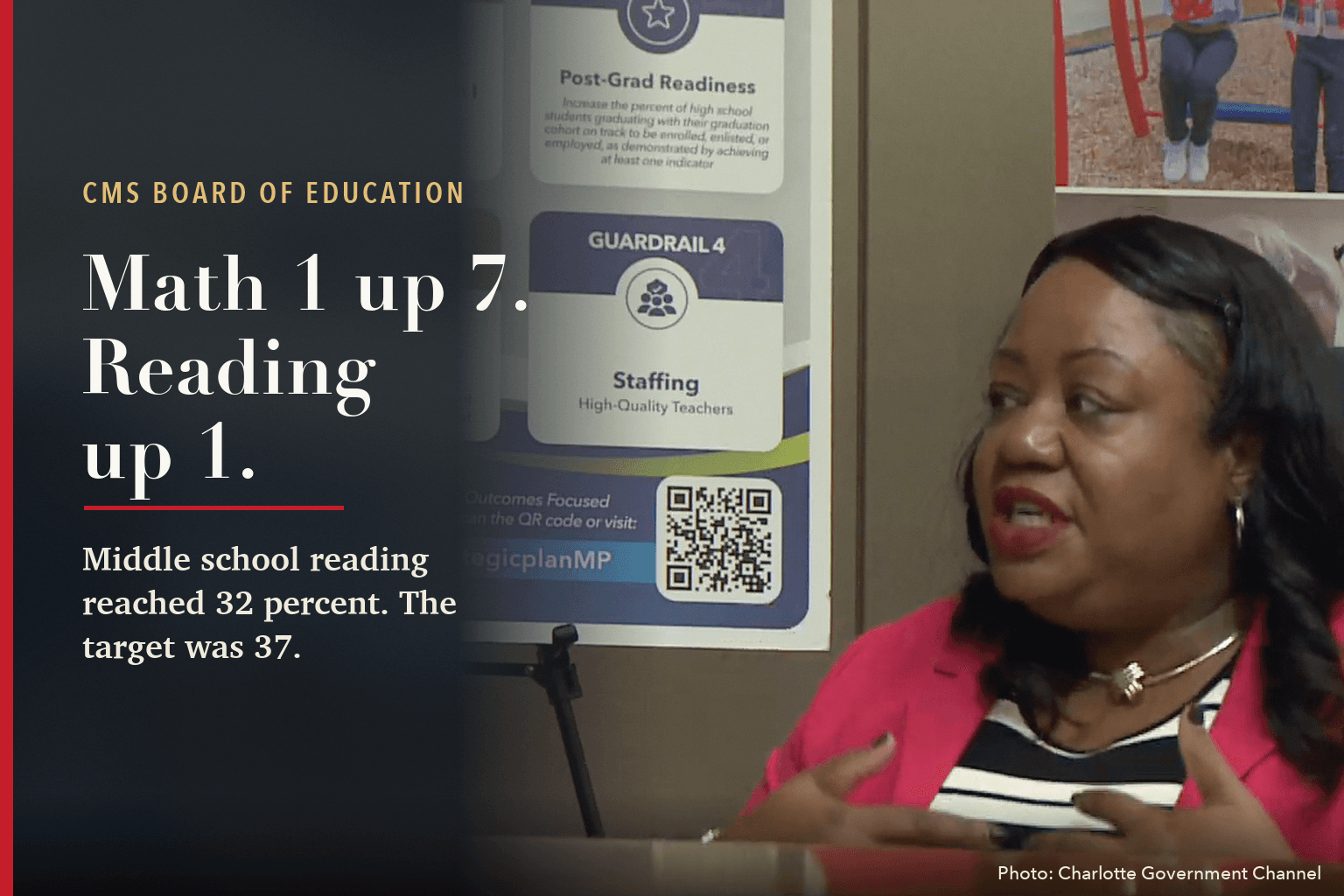
Charlotte-Mecklenburg Schools students made their biggest gain in Math 1 last school year in the four years the school board has tracked it. In middle school reading, they barely moved.
The share of Math 1 students who scored college and career ready, a higher bar than grade-level proficiency, rose seven points, to 36 percent, the district told the Board of Education on Tuesday. In grades 6 through 8, the share reading at that level rose one point, to 32 percent. The target was 37.
To reach this year's reading target of 41 percent, middle schools would have to gain nine points in a year. Vice Chair Liz Monterrey Duvall said she does not see that acceleration in the trend. "We only had a one point growth last year," she told Acting Superintendent Melissa Balknight. "I think we need to have like a velocity plan." She asked whether staff had considered a smaller step. "I would feel more comfortable if we said, hey, nine points is a bit high," she said. "Maybe it's five."
"You have talked about that for the last two years," Balknight answered. "You have pushed back on us, and I think it's a valid comment and question." The district has added a layer to its strategy each year, she said, and all of them are now in place. "Now, we can't guarantee that we can get to the 9%, but you should see more than a 1% rapid acceleration."
What moved in math
CMS students can take Math 1 in middle school, where it is an advanced course, or in high school, where it is on grade level. Across both, the share of students ready for college and careers had been 27, 28 and 29 percent in the three years before. The target last year was 42 percent.
Every student group gained, but not equally. White students went from 58.2 to 68.1 percent and Black students from 15.1 to 20.9, so the gap between them widened, from 43 points to 47.
In middle school the gain was bigger and the gap shrank. Ninety percent of middle school Math 1 students scored college and career ready, against a target of 80. Black middle schoolers went from 55 to 80.8 percent, the largest gain of any group, and their gap with white students narrowed from 27 points to 12.
Two years ago, Balknight said, the district began reviewing how it places students in middle school Math 1, "because what we found is that we were placing kids that weren't ready for Math 1." It also began requiring the teachers to hold the local endorsement for teaching gifted students, known as AIG. Asked what drove the growth, she called the endorsement "the biggest training piece." She could not say every teacher has it yet. "I can't say here today that we have 100%," she said.
Board Chair Dee Rankin said he did not want to "glaze over" the gain. "That is huge," he said.
“No, we're not where we want to be, but we're not where we used to be.”
Dee RankinChair, Charlotte-Mecklenburg Board of EducationVideo: Charlotte Government Channel
Balknight singled out Ranson Middle School, which she said had long been identified for low performance. "Ranson is on fire," she said. "In a positive way."
The high school Math 1 results are scheduled for Oct. 27, on the district's reporting calendar.
Where reading stands
Across grades 3 through 8, reading readiness rose two points, to 35 percent, against a target of 40. In middle school, it fell for multilingual learners, from 3.5 to 2.9 percent, and for students with disabilities, from 4.6 to 4.4 percent. Black and Hispanic middle schoolers each gained less than two points, to 21.6 and 18.1 percent.
Board member Lenora Shipp asked about the one-point change. "I'm concerned there," she said. "What happened?" Balknight said a nine-point rise "is a large increase" and pointed to "strategic scheduling" and closer tracking of each student's data. In other answers she described previewing lessons ahead of time for the students furthest behind.
“Now, we can't guarantee that we can get to the 9%, but you should see more than a 1% rapid acceleration.”
Melissa BalknightActing Superintendent, Charlotte-Mecklenburg SchoolsVideo: Charlotte Government Channel
One school has moved. At Charlotte East Language Academy, a K-8 dual-language Title I magnet, the share of students college and career ready in reading has risen from 9.8 percent to 32.6 percent since the pandemic, Principal Sarah Lang told the board. Half of all content there is taught in Spanish, she said, and the tests are in English. The school opened with a report card grade of F and is now "only two small points away" from a B.
Board member Charlitta Hatch asked whether what worked in Math 1 could work in reading. Balknight said the district is considering one piece of it for reading teachers: the same kind of required local endorsement.
Related coverage