
Key Takeaways
- Brendan K. Maginnis, the runner-up in Charlotte's September 2025 Democratic mayoral primary, sent the City Council a letter Friday from Copenhagen asking to be considered for the interim mayor appointment after Vi Lyles's June 30 resignation
- Maginnis's family moved to Copenhagen in January; he remains registered to vote in Mecklenburg County, with Charlotte as his primary legal voting residence, satisfying eligibility under N.C.G.S. 160A-63
- In follow-up emails to the Mercury, Maginnis volunteered a demographic argument: by his count, 44 Democratic elected officials represent Charlotte at various levels and none are white males in a city where white males are roughly 20 percent of the population (revised from approximately 46, see the body-by-body breakdown in the update below)
- The Mercury verified the math for the Charlotte City Council itself, where 11 of the 12 elected positions are held by Democrats and none of those 11 are white males
- Maginnis's pitch collides with Charlotte-Mecklenburg NAACP President Corine Mack's public call for the council to elevate the Mayor Pro Tem rather than install a placeholder
- Maginnis is willing to commit to not running for mayor in 2027, with a qualifying clause; he is the second outside name to publicly volunteer for the appointment, after former Mayor Jennifer Roberts
Brendan K. Maginnis, the runner-up in Charlotte's September 2025 Democratic mayoral primary, sent the City Council a letter Friday asking to be considered for the interim mayor appointment when Vi Lyles resigns on June 30. He sent it from Copenhagen.
His family moved to Copenhagen in January. He is still registered to vote in Mecklenburg County, and Charlotte remains his primary legal voting residence, he told The Charlotte Mercury Friday evening. If the council appoints him, he said, he will be in Charlotte for "all required City Council meetings and mayoral duties" while continuing to spend time with his family in Copenhagen, an arrangement he described as a Charlotte benefit, one that would allow him to "observe successful solutions abroad and help establish strong beneficial ties between our city and Denmark." He compared it, unprompted, to what he said Lyles had done with her family in Washington, D.C.
Maginnis volunteered a second argument. By his count, initially approximately 46 Democratic elected officials representing Charlotte at various levels, revised to 44 in a follow-up email Saturday morning (see update below), zero of them are white males, in a city where white males are roughly 20 percent of the local population. Appointing a qualified white male, he wrote, "would send a strong, visible message that Democrats practice the inclusion we preach." It would "help demonstrate that we do not have an innate bias and would counter the perception that certain voices are no longer welcome in local leadership."
That is the pitch, in his own words. It collides with the most public on-record position so far on the appointment: Charlotte-Mecklenburg NAACP President Corine Mack told WBTV that the council should elevate the Mayor Pro Tem rather than install a placeholder, and should drop the convention that an interim appointee not run in 2027. Mack's argument is that the moment is too consequential for a placeholder. Maginnis is making the opposite case: that the moment is too consequential to overlook the demographic he says is missing from Charlotte's elected Democratic ranks.
What the math actually says
Maginnis initially put the count at approximately 46 Democratic elected officials representing Charlotte at various levels without enumerating which bodies. In a follow-up email Saturday morning he revised the figure to 44 and attached a body-by-body breakdown, see the update at the end of this piece. The Mercury did not finish the audit in time to repeat either figure as fact.
What is verifiable is the body he most directly wants to join. The Charlotte City Council seats twelve elected officials, the mayor and eleven councilmembers. After the November 2025 general election, 11 of those 12 are Democrats. Of those 11 Democrats, none are white males: Mayor Vi Lyles, Danté Anderson (District 1), Malcolm Graham (District 2), Joi Mayo (District 3), Renee Perkins Johnson (District 4), Juan Diego Mazuera Arias (District 5), Kimberly Owens (District 6), and the four at-large councilmembers, Dimple Ajmera, Victoria Watlington, Mayor Pro Tem James "Smuggie" Mitchell Jr., and LaWana Slack-Mayfield. The lone Republican on the council, District 7's Ed Driggs, is also the lone white male elected to the body. Under North Carolina law, the appointment must go to a Democrat, which leaves Driggs out.
The council-level math lands where Maginnis said it would. The broader figure, revised from approximately 46 to 44 in his follow-up email, is his to defend.
The residency question, answered
WSOC's Joe Bruno first surfaced the offer Friday afternoon. Some early coverage characterized Maginnis's situation as a relocation to Denmark; other reporting described it as a four-month stay in Copenhagen studying transit, housing, and infrastructure. The two framings carry different implications under N.C.G.S. 160A-63, the section of state law governing eligibility for municipal office. Maginnis told the Mercury that the second framing is closer to right, he and his family moved to Copenhagen in January, he kept his Mecklenburg voter registration intact through the move, and Charlotte has remained his primary legal voting residence throughout.
That settles the eligibility question. It does not settle the practical one.
The Budget, Governance, and Intergovernmental Relations Committee Graham chairs is currently building the FY27 budget. The May 11 council meeting carried the I-77 South resolution, the data-center moratorium discussion, and the third Housing Trust Fund cycle. Whoever fills the seat between July 1 and the November 2027 election inherits the Metropolitan Transit Authority handoff, the November 2026 transportation-and-housing bond referendum, and a long-term airport lease that Graham last week called the council's next major lift, "due in months."
Maginnis framed the Copenhagen commute as a feature. The eleven councilmembers weighing his name will read that framing for themselves.
The 2027 pledge, with a caveat
Graham has said publicly that the interim appointee should commit not to run for mayor in November 2027, so the seat doesn't function as an incumbency springboard. Danté Anderson, the District 1 councilmember and former mayor pro tem, has said she will not seek the appointment herself and would not commit to a 2027 run. Asked directly whether he would make the same pledge, Maginnis told the Mercury he is willing to. His intention, he wrote, would be "to join my family full-time in Copenhagen after the term ends, while maintaining the possibility of continuing to represent Charlotte through any ties that have been established."
Who Maginnis is, in the public record
Maginnis is a former US Marine, a former Ameriprise Financial advisor, and vice president of Maginnis Bros. Holding Company, a small business. He has run for federal office twice and for city office once, a US Senate Democratic primary in 2022, a US House Democratic primary in 2024, and the Charlotte mayoral primary last September.
That last one is what puts him in the conversation. The September 9 Democratic primary was a multi-candidate race; Lyles took over 70 percent and Maginnis took 12.3 percent, second place. Lyles went on to a fifth two-year term in November.
Among the names in public circulation for the appointment, two are outside the council. Former Mayor Jennifer Roberts volunteered first, telling WBTV last week she would serve if asked. Roberts is Charlotte's 58th mayor, the incumbent Lyles defeated in 2017. Maginnis is the second.
He is the first of the two to come with both a residency complication and a demographic-counter pitch.
What comes next
The council has not yet scheduled the appointment process. Graham said publicly last Sunday that the Budget, Governance, and Intergovernmental Relations Committee he chairs "may" be where the formal process is handled, and that nothing has been decided. Mitchell, the Mayor Pro Tem, told WBTV he wants the seat filled by July 1. Lyles's last day is Tuesday, June 30.
Whatever combination of pledge, residency, and demographic argument the eleven councilmembers find persuasive will be decided by a vote, not an essay. For the Fourth Ward, the math runs through Graham's committee and his colleagues' votes. Anderson, Graham, and Mack have not publicly commented on Maginnis's letter as of deadline. The piece will be updated if they do.
The vote that decides who fills it has not been scheduled.
Update, May 18, 2026
Maginnis emailed The Mercury on Saturday morning with a revised total: 44 Democratic elected officials representing Charlotte, not approximately 46. He attached a body-by-body breakdown to support the count.
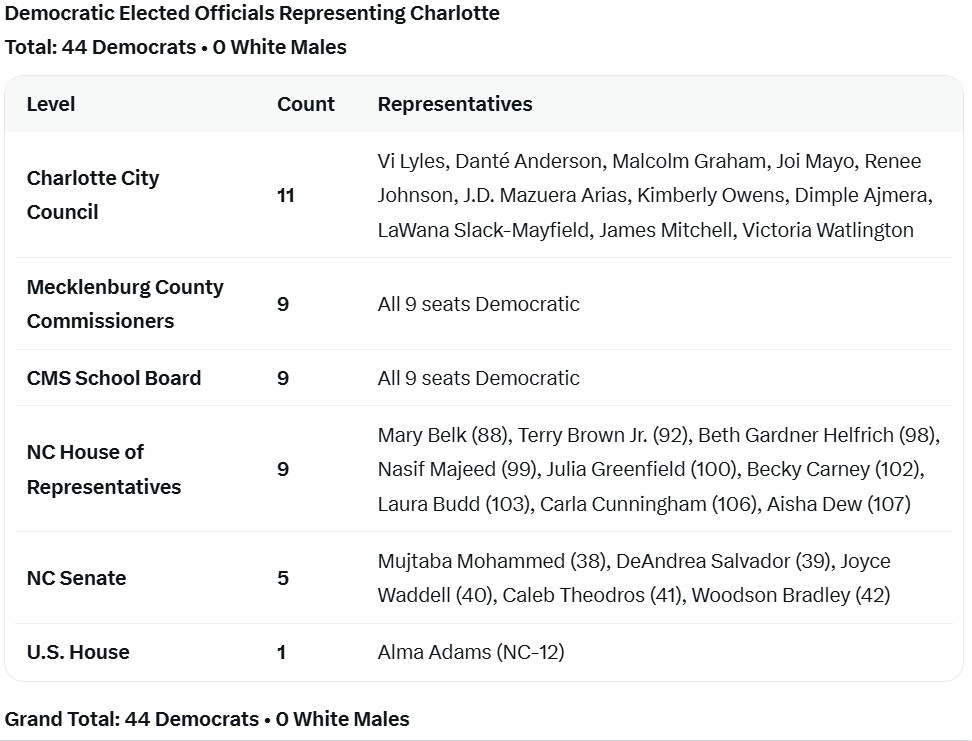
By his accounting: 11 on Charlotte City Council, 9 on the Mecklenburg Board of County Commissioners, 9 on the CMS Board of Education, 9 in the NC House (Districts 88, 92, 98, 99, 100, 102, 103, 106, and 107), 5 in the NC Senate (Districts 38, 39, 40, 41, and 42), and 1 in the U.S. House, Alma Adams, NC-12. The tally lands at 44 Democrats, zero white males.
The Mercury has not yet independently verified each body's roster against Maginnis's count. That sweep is open and will be reflected here when it's complete.