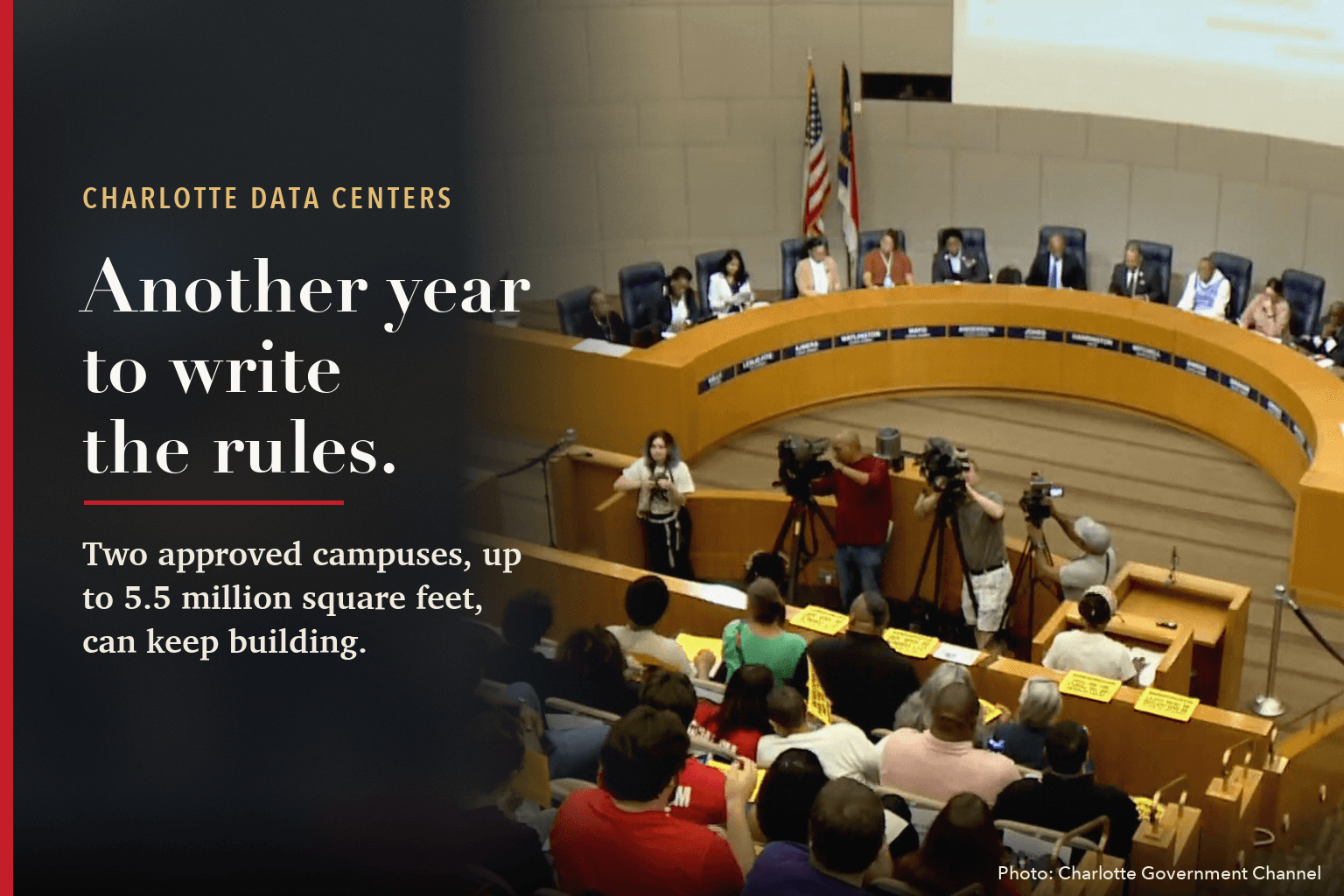
Charlotte paused new data centers four months ago to give itself time to write rules for them. On Monday, city staff asked the City Council for almost a year more.
Whatever rules come out of it, the two hyperscale campuses the city has already approved, data centers of a million square feet or more off University City Boulevard and Moores Chapel Road, can keep building under the approvals they have. Together they are allowed up to 5.5 million square feet of data center space, about 95 football fields. The city lists both as exempt from the moratorium under state law, because council approved their rezonings before it began.
"We cannot simply tell University City and Moores Chapel residents that their projects were approved before we recognized these concerns and there's nothing more we can do," Council Member Reneé Johnson said.
That gap, between what Charlotte is studying and what it can require, ran through two hours of presentation, public comment and council debate. Council members said much of the power they want sits in Raleigh, where the General Assembly has limited what cities can take away from a property owner's zoning.
Council adopted the 150-day moratorium unanimously June 8, after a 5-5 tie in April over whether to even schedule a hearing, which the mayor at the time broke against it. It pauses new data center and telecommunications applications in the city and the area outside it where Charlotte controls zoning, and it runs through Nov. 5. Council held a public hearing on the extension Monday and took no vote on it. Mayor Rob Harrington said he expects a decision at the Oct. 26 meeting.
What the city says it still needs
To extend a moratorium, state law requires the city to show good-faith efforts toward the original goals and new facts and conditions that justify more time, said Heather Bolick, the city's chief sustainability and resilience officer. Her recommendation: extend it to Oct. 18, 2027.
"Impacts of data centers are complex and require the city to employ tools we do not currently have," Bolick said. Staff and members of the city's data center task force, she said, "acknowledge that Charlotte lacks specific regulatory tools like capacity verification, monitoring protocols, and cooling standards."
Updating the Unified Development Ordinance, the city's zoning rulebook, would take three to six months, she said, and a noise strategy six to nine, because it needs city and county departments working together. Staff would also hire a consultant, set different standards for data centers by size and type, and work with agencies and companies outside the city's control, including the N.C. Department of Environmental Quality, the N.C. Utilities Commission and Duke Energy.
Up to 5.5 million square feet, already approved
Johnson asked staff how big the two approved projects are. Terrie Hagler-Gray, an assistant city attorney supervisor, gave the numbers: the University City site is 123.80 acres and would allow up to a 2.5-million-square-foot data center, and the Moores Chapel site is 156.23 acres and would allow up to 3 million square feet.
Johnson called both projects hyperscale. Council Member Dimple Ajmera, who sponsored the original moratorium, used the term Monday for facilities of "million square feet plus," as opposed to smaller ones that serve one or two organizations.
"But we cannot require the developers of the hyperscale near residential areas to enact any of the improvements that we find necessary," Johnson said. She said she and Council Member LaWana Mayfield voted against the University City rezoning.
“So we're talking about almost, well, 5.5 million square feet data centers.”
Reneé JohnsonCharlotte City Council, District 4Video: Charlotte Government Channel
Which new rules could reach them
Ajmera asked whether rules adopted at the end of the moratorium would apply to data centers already approved.
"No, that's not correct," Hagler-Gray said. When Ajmera pressed, she added: "Actually, noise would likely apply to the existing data centers." Changes to the noise and lighting ordinances, and possibly water policies, could apply, she said. Both sites are outside city limits, county tax records show, and the city's noise ordinance is written for noise "in the city." The city has not said whether a change would reach them. When Johnson asked again near the end of the discussion, Hagler-Gray restated it: "Right now, that data center is exempt from the moratorium per state law and can develop under the entitlements that were approved under the conditional rezoning."
Ajmera asked staff for a memo setting out which rules could reach the existing sites and which could not. She also pointed to water reporting. "Currently there is no specific requirement around how much water that one or multiple facilities use," she said, and without reporting, the city can't measure the impact.
Council Member Joi Mayo said neighbors near the Moores Chapel site won some protections when it was rezoned, through the Northwest Community Alliance. "They were able to do a closed loop system for the water," Mayo said. "They were able to have like 50 acres donated for a park."
Two miles from Moores Chapel
Twenty-eight people spoke at the hearing. Kathy Sparrow said she has lived for 50 years in unincorporated west Mecklenburg, about two miles from the Moores Chapel site, outside the city and without a council member of her own.
"We didn't get to vote for any of you guys," she said. "We worry about our water. My family and most of my neighbors have wells. How will this huge data center impact our wells, both with water shortages and with groundwater pollution?"
“I speak at this meeting in the hopes that other Mecklenburg County residents do not have to experience the hopelessness and helplessness of learning about our data center neighbor after it is too late to do anything.”
Kathy SparrowWest Mecklenburg residentVideo: Charlotte Government Channel
Several residents and a task force member asked for a longer pause, 32 months in some cases. Tim Sittema, another task force member, asked for a shorter one. "I do agree that we need more time to develop a thoughtful policy around data centers," he said. "And I don't believe we need another year to get it right."
The trades want rules, and the work
Seven speakers came from unions. Melissa Reyes, an organizer with Local 379 of the International Brotherhood of Electrical Workers, the electricians' union, said the local has roughly a thousand members working on data center projects in the Charlotte area. Most of the union speakers asked for rules, not a ban: data centers that pay their own power costs, protect water and respect their neighbors.
"We should not have to choose between protecting our communities and protecting our livelihoods," said Jessica Wilson, a union electrician with the IBEW. One IBEW electrician asked council to lift the moratorium and judge projects one at a time under clear standards.
Larry Shaheen, who described himself as a board member of the Commercial Real Estate Development Association, questioned whether extending the moratorium fits state law when the city may lack the authority to adopt the rules it wants to study. The General Assembly "has significantly restricted the ability of local governments to downzone property without the written consent of affected property owners," he said. Downzoning means cutting what an owner is allowed to build.
The answer may come from Raleigh
No council member spoke against extending the moratorium. Several said the tools they want are in Raleigh.
Council Member Kimberly Owens said she would support it "even though I am a strong union supporter," and said the city can't do what other states have done "because the legislature has tied our hands." She urged the trades and residents to press legislators for downzoning authority. "I do not believe that Charlotte needs another hyperscale by any stretch of my imagination," Owens said.
Council Member Ed Driggs pointed to two bills in the General Assembly, Senate Bill 730 and House Bill 1189, that he said address many of the same issues.
Council Member Danté Anderson asked whether an extension could end early if the state acts first. Hagler-Gray said the current ordinance runs to Nov. 5 "or upon city council approval of new regulations and our policies regarding data centers, whichever occurs first." If the legislature provides relief and staff are ready with new rules, she said, "we could do that and not have to extend the moratorium into the actual date. The moratorium could end earlier."
What's next
Council is expected to vote on the extension Oct. 26. The current moratorium ends Nov. 5. Staff have not said when Ajmera's memo on the two exempt sites will be ready.