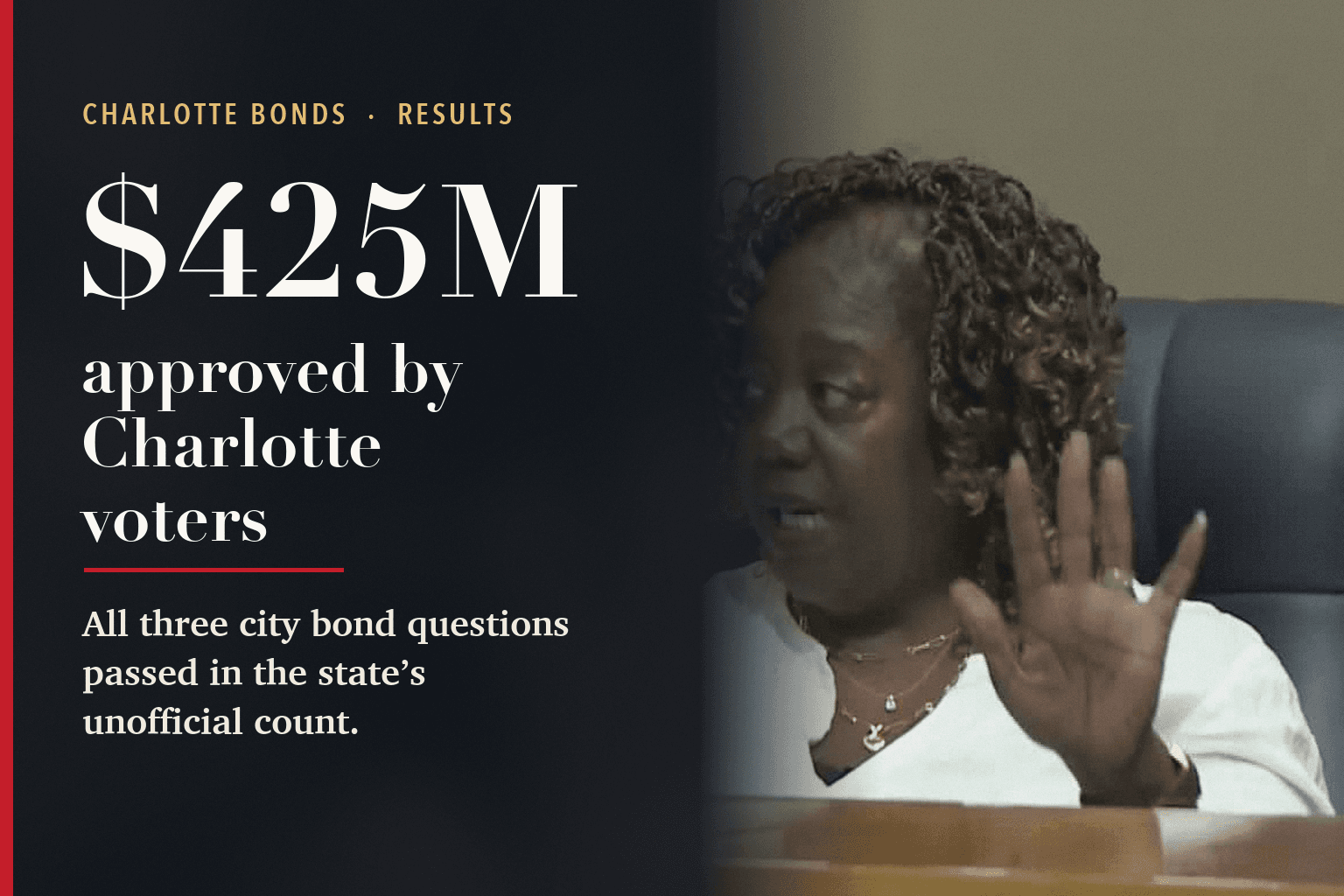
Charlotte voters on Tuesday approved all three city bond questions, letting the city borrow $425 million: $125 million for affordable housing and $300 million for streets, sidewalks and neighborhood projects.
The housing money comes after Council Member LaWana Mayfield, who chairs the council's housing committee, warned her colleagues on Sept. 14 that the account the city uses to help people make a down payment on a home was at zero. "We don't have enough in the budget right now to buy a single home in the city of Charlotte," she said, "much less to help with down payment assistance." She pointed to the housing bond as the next source of money.
All three passed easily. The neighborhood bond drew the most support, about two in three voters. The housing bond drew the least, 61.9 percent, and still won by nearly 77,000 votes.
| Bond | Yes | No | Yes share |
|---|---|---|---|
| Transportation | 204,868 | 116,785 | 63.7% |
| Housing | 199,281 | 122,477 | 61.9% |
| Neighborhoods | 214,184 | 107,632 | 66.6% |
The counts are unofficial, from the North Carolina State Board of Elections' precinct results as of Wednesday morning. They become official after the Mecklenburg County Board of Elections completes its canvass, the formal check that every vote was counted and tabulated correctly, on Friday, Nov. 13.
The housing money will go to the city's Housing Trust Fund, the pot developers apply to for affordable housing projects. Council set the spending goals on Oct. 12, in a policy that made them dependent on Tuesday's vote: $38 million for new rental housing, $31 million for homeownership, $18 million to preserve existing rentals and help residents stay in place, and smaller amounts for shelter, repairs, land and other uses. The policy also sets a $35 million goal for neighborhoods with strong schools and jobs that have seen little affordable housing investment.
The transportation and neighborhood questions name no projects. City Manager Marcus Jones's budget in May listed the largest planned uses of that money: $60 million for what the city calls Strategic Investment Areas, $50 million for sidewalks, $24 million for street resurfacing and $22 million for Vision Zero traffic and pedestrian-safety projects.
With interest, the three bonds will cost about $667 million to repay, by the ballot's estimates added together, which assume the highest rate charged for similar debt in the past 20 years. The ballot put the property tax increase needed at an estimated $0.00 a year per $100,000 of value, though each question allows the city to raise property taxes by enough to repay the bonds. Under the plan city staff laid out in March, the transportation and neighborhood bonds would be repaid with sales tax money under the PAVE Act, the state law that funds Charlotte's road program, plus at least a share of existing property tax. The housing bond has no dedicated source of repayment.
Asked in September whether the city's homeownership money gets used, Warren Wooten, deputy director of Housing and Neighborhood Services, said the city is "constantly called for additional down payment assistance."