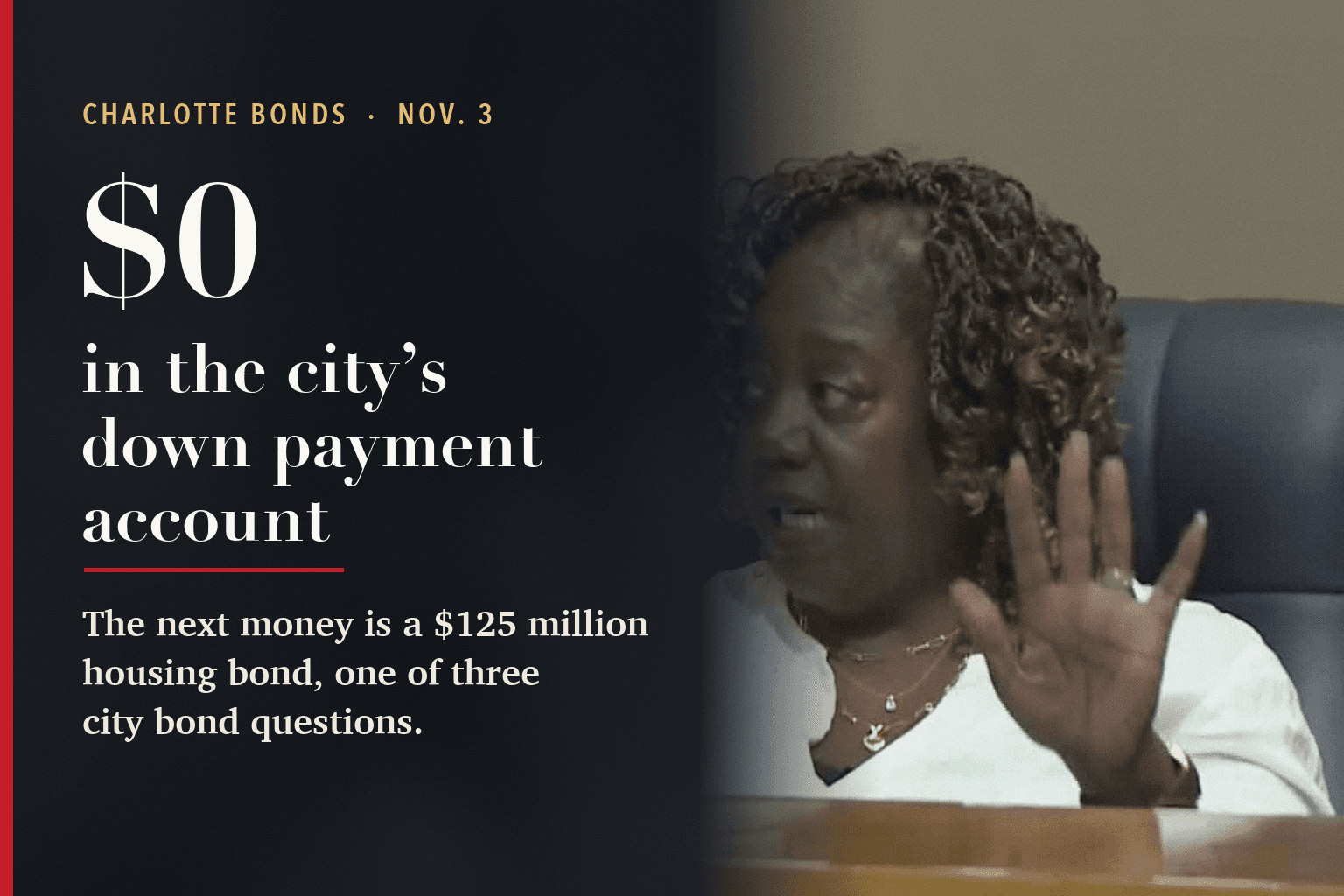
The account Charlotte uses to help people make a down payment on a home was at zero last month, City Council Member LaWana Mayfield, who chairs the council's housing committee, told her colleagues. The next money, she said, is a $125 million housing bond on the November ballot, and that is not guaranteed.
"We don't have enough in the budget right now to buy a single home in the city of Charlotte," she said, "much less to help with down payment assistance."
The housing bond is one of three questions on the ballot for voters who live in Charlotte. Together they would let the city borrow $425 million: $280 million for transportation, $125 million for affordable housing and $20 million for neighborhood improvements. Each question estimates the property tax increase needed to repay it at $0.00 a year per $100,000 of value. And each, in the same question, would allow the city to levy additional property taxes in an amount sufficient to repay it.
Early voting ends at 3 p.m. Saturday. Election Day is Tuesday, Nov. 3.
What the ballot says
| Question | Amount | Estimated cost with interest |
|---|---|---|
| Transportation | $280 million | $437.1 million |
| Housing | $125 million | $198.4 million |
| Neighborhoods | $20 million | $31.2 million |
The cost estimates assume the highest interest rate charged for similar debt over the past 20 years.
How the city plans to repay it
The ballot does not say how the city arrived at a zero estimate. The repayment plan city staff laid out for council in March splits the bonds between two sources.
Under that plan, the transportation and neighborhood bonds, $300 million together, would be paid for with sales tax revenue under the PAVE Act, the state law that funds Charlotte's road program. Housing has no dedicated source. It competes with public buildings for the city's general revenue, and staff said in March that how large a housing bond the city can afford depends on how much of that revenue council puts in.
That revenue runs through the Municipal Debt Service Fund, whose available money is already planned for future housing and public-facilities bonds. In September, City Attorney Andrea Leslie-Fite told council that the state's $69.6 million claim against Charlotte, for walking away from the I-77 South toll lanes, would come out of that fund. Council voted 7-4 on Sept. 21 to reinstate its support for the toll lanes, which exempts the city from the claim.
What the housing money would buy
The $125 million would go to the city's Housing Trust Fund, the pot developers apply to for affordable housing projects. Jones's May budget described it as $100 million for the fund plus a one-time $25 million anti-displacement increase.
That is more than the $100 million bond voters approved in 2024, and well above the $50 million city staff proposed in March. Council Member Malcolm Graham, who chairs the budget committee, called the $50 million a non-starter.
The plan staff presented in September splits the money across nine categories, led by $38 million for new rental housing and $31 million for homeownership. Homeownership got the largest increase over 2024, $6 million. Asked whether that money is being used, Warren Wooten, deputy director of the city's Housing and Neighborhood Services department, said the city is "constantly called for additional down payment assistance."
The plan also sets goals of up to $25 million for housing near planned transit lines and up to $35 million in neighborhoods with strong schools and jobs.
What the city has proposed for the street money
The ballot language for transportation and neighborhoods is broad: streets, intersections, sidewalks, bike paths, drainage, bridges, signals and the land needed for them. It names no projects.
City Manager Marcus Jones's budget proposal in May listed the largest pieces of the combined transportation and neighborhood package: $60 million for what the city calls Strategic Investment Areas, $50 million for sidewalks, $24 million for street resurfacing and $22 million for Vision Zero traffic and pedestrian-safety projects.
When to vote
Early voting runs through Saturday, Oct. 31, at 25 sites in the county, and any site works. Hours are 8 a.m. to 7:30 p.m. on weekdays and 8 a.m. to 3 p.m. on Saturday.
On Election Day, Tuesday, Nov. 3, polls are open 6:30 a.m. to 7:30 p.m., and voters must go to their assigned polling place. The rest of the ballot is on our elections page.