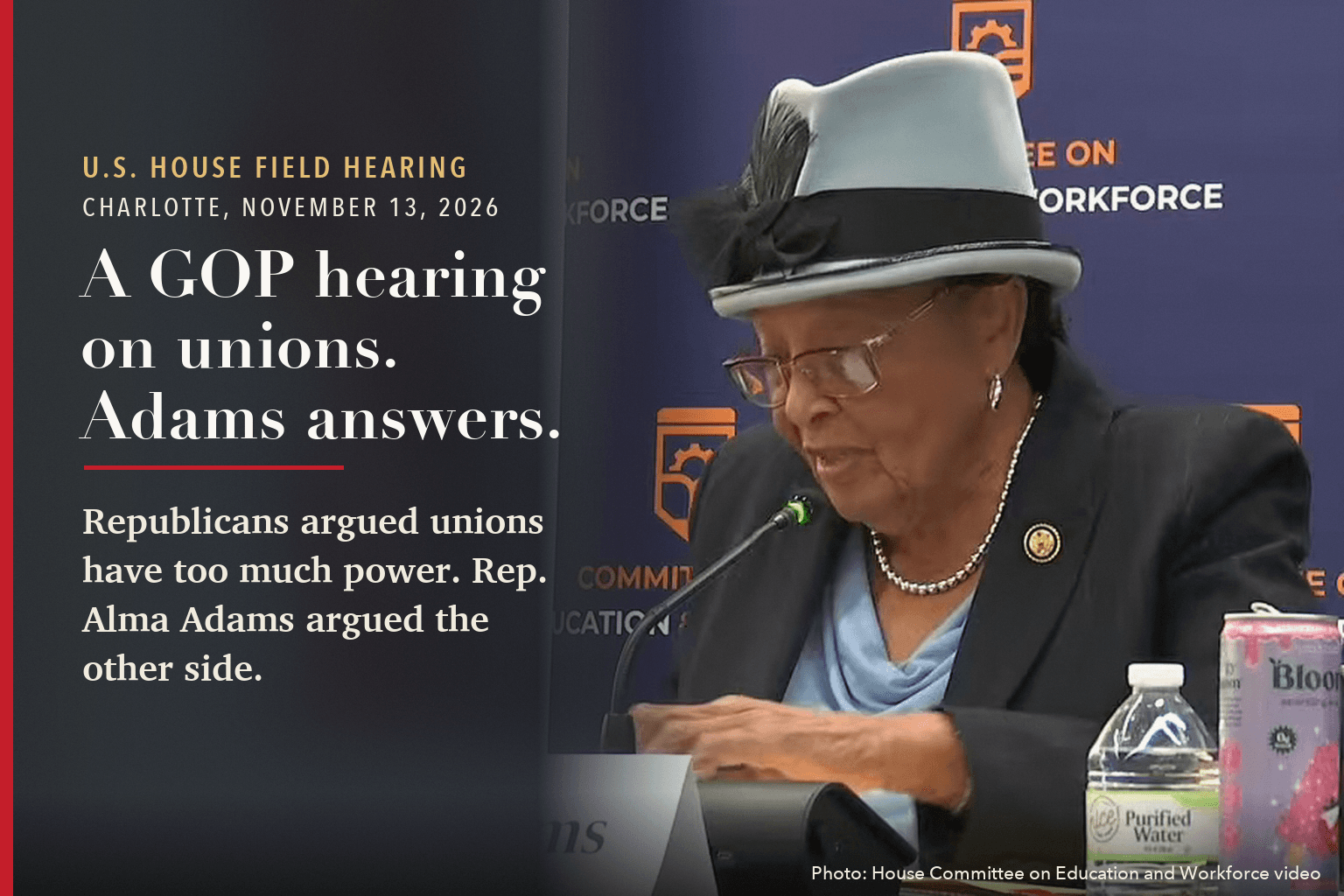
House Republicans held a hearing in Center City Charlotte on Friday, Nov. 13, on whether workers have enough say over the unions that represent them. Three witnesses testified. None was from North Carolina.
They came from a legal foundation in Springfield, Virginia, a law firm office in Pittsburgh and a Ford plant in Michigan. The only person who talked about Charlotte's own workers was Rep. Alma Adams, the Democrat who represents North Carolina's 12th District, where the hearing was held. She told the committee in her opening remarks that she could not stay for the whole hearing, and she asked no questions.
What the hearing did offer was a preview of a fight both parties said is coming in January, when Democrats expect to hold the House majority, and a debate in which North Carolina was held up on both sides.
North Carolina as the model
The House Committee on Education and Workforce held the session as a field hearing, at the Dubois Center at UNC Charlotte Center City. Rep. Mark Harris, the Republican who represents North Carolina's 8th District and won reelection this month, ran it. Rep. Burgess Owens of Utah was the only other member who asked questions.
William Messenger, vice president and legal director of the National Right to Work Legal Defense Foundation, opened by praising the state's laws. "It's fitting that this field hearing is happening in North Carolina because North Carolina's labor laws are a model of voluntary unionism that the federal government should try to emulate," he said. Under North Carolina law, he said, no public employer can be forced to bargain with a union, and no worker can be made to join or pay one.
Adams had already given the other view. "Workers in North Carolina and many other states have suffered under so-called right-to-work laws," she said. The name, she said, should be "the right to a low wage, the right to poverty, and the right to be exploited by your boss."
Over the last 50 years, she said, unions in North Carolina have gone from representing about 10% of workers to about 3%.
The people Adams described
Adams spent most of her time on the people the hearing was supposed to be about. An adult in Charlotte needs to make about $25 an hour to cover basic expenses, she said, and many of her constituents make far less.
"I've met with working people in my district who are forced to live in storage units and cars and on the street," she said. "And I can promise you they aren't lazy." They are airport baggage handlers, grocery cashiers and restaurant workers, she said, in a state that bars local governments from changing wage rates even when they want to.
She was blunt about the witnesses. "I see the interests of the wealthy are well represented by our witnesses here today," she said.
What Republicans want
Harris said federal labor law gives union leaders too much power and members too little. Unions are not required to let members vote on contracts or strikes, he said, and he wants secret-ballot votes on both, through a bill he introduced, the Ask the Union Members Act.
He aimed most of his fire at a Democratic bill, the Faster Labor Contracts Act, which he said would put government arbitrators in charge of writing labor contracts. The result, he said, would be "fuller pockets for union leaders and less power for the workers they represent."
Terry Bowman, an incoming quality technician at a Ford plant in Michigan who has worked there more than 30 years and chairs the Institute for the American Worker, said that bill would let an arbitration panel "force workers into union contracts without workers' approval." Jennifer Betts, a management-side labor lawyer at Ogletree Deakins in Pittsburgh, said she had walked clients through two and sometimes three or more reversals of labor board precedent on the same issue, and asked Congress for rules that do not change with each administration.
What Democrats plan
Adams said Democrats would move the other way once they hold the majority. "When Democrats take power in January, we'll pass a strong pro-worker agenda," she said. She named the Faster Labor Contracts Act and the PRO Act, a broader union-rights bill, and said Democrats would fight to end right-to-work laws.
She took no part in the questioning. When it began, Harris called on her, corrected himself and moved to Owens. At the end, he thanked Owens for coming to Charlotte. The committee kept the record open for 14 days for written statements.