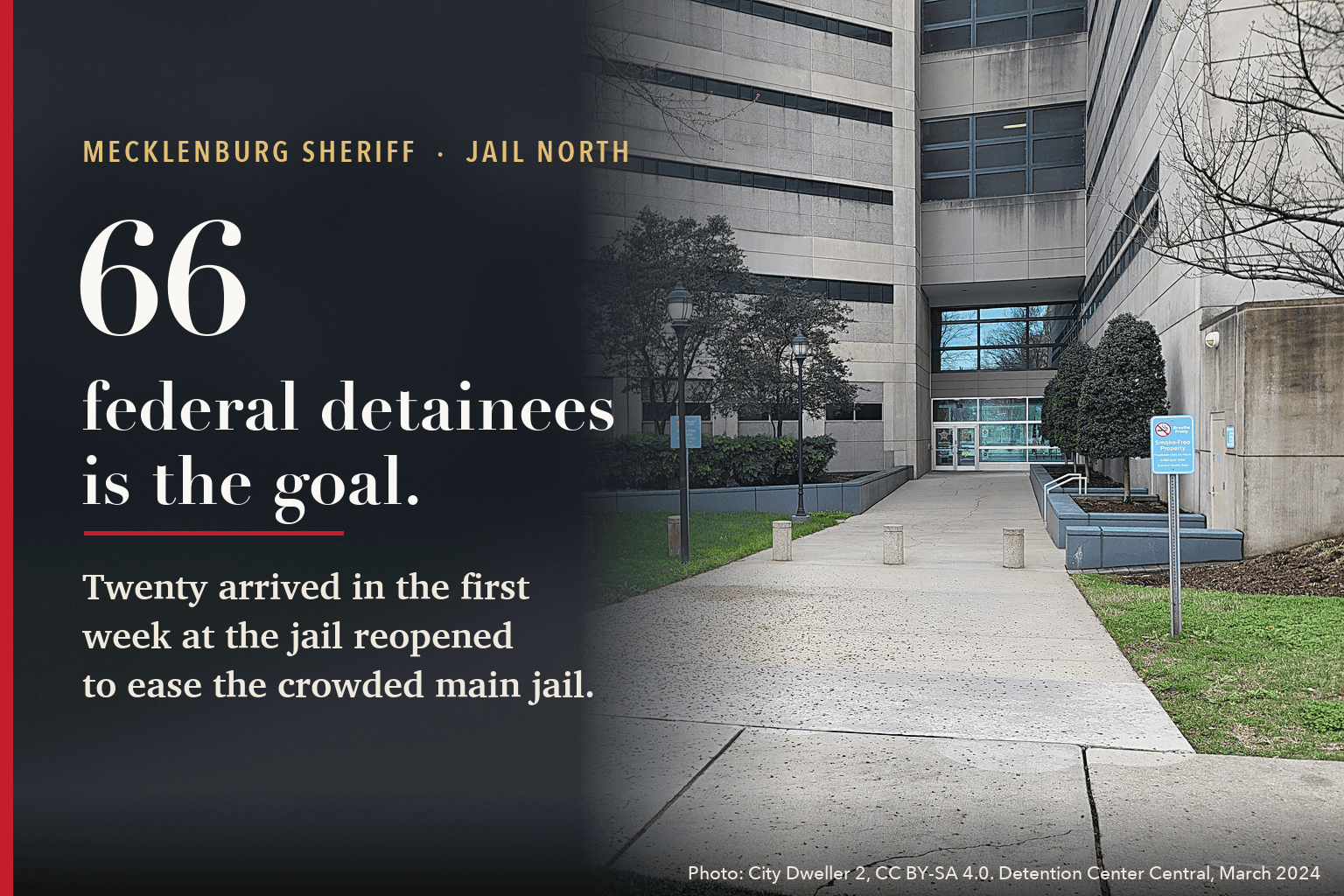
When Mecklenburg County commissioners voted in September to reopen the North Detention Center, the budget counted on $1.9 million from housing federal inmates. On Monday, Nov. 2, the first of them arrived.
By Friday, the jail, known as Jail North, had received 20 detainees for the U.S. Marshals Service, the Mecklenburg County Sheriff's Office said in a Nov. 6 statement. It will keep taking them "until it reaches its goal of 66." The statement does not say what the Marshals Service pays, how long the arrangement runs or where in the building the detainees are held.
People charged with federal crimes are in the Marshals Service's custody from the time a federal court orders them held until they are acquitted, or convicted and sent to federal prison, according to the agency. To hold them, it rents space in local jails. The Sheriff's Office statement does not describe the charges against the people now at North.
The county reopened North to take the overflow from its crowded main jail, Detention Center Central. The county's agenda item put the cost at $3,813,591. Shifting $600,000 within the sheriff's budget brought that to $3,213,591, which commissioners approved on Sept. 1. Most of it was to be covered by $1,916,250 in revenue from housing federal inmates, $800,000 from housing the state prison backlog and a $150,000 grant the item calls SCAAP. The last $347,341 was to come from the Sheriff's Special Revenue Fund.
"All that to say there is no impact to county dollars," Andrey Melkonyan, the Sheriff's Office business operations director, told commissioners.
The fund holds concealed handgun permit revenue the sheriff has built up over the years, a Sheriff's Office official said. Vice Chair Leigh Altman asked whether the office would need ongoing money once the fund was spent. The answer: "That is correct." Asked whether the fund would keep covering the cost, Sheriff Garry L. McFadden said maybe, but that if lawmakers in "Raleigh and D.C." changed things, "we may not have it."
"We look forward to building on this successful collaboration and working more closely with United States Attorney Russ Ferguson and Chief Chris Edge of the United States Marshals Service in the years ahead," McFadden said in the Nov. 6 statement.
Where the detainees fit
The agenda item said opening part of North would add 224 beds, "with maximum potential of 250 beds, based on the medical staffing plan." On Sept. 17, the Sheriff's Office moved 209 people into four housing units there from Central. The next day it said about 189 people at Central were still sleeping on stack-a-bunks, temporary beds set up in overflow space, and that 72 of them should already have been in state prison.
On Oct. 14, county staff told commissioners that four pods were in operation at North. The Nov. 6 statement does not say whether the office has opened more of the building.
Talks were public by June
By June, while it was getting ready to reopen North, the Sheriff's Office was talking publicly about federal detainees. It said it had "revisited conversations with the U.S. Marshals Service," and that they were "positive and productive towards the return of federal detainees to Mecklenburg County." A tour of North had been conducted, it said. No formal contract or agreement had been reached and the number of detainees had not been disclosed, the June 5 statement said.
A jail over capacity
At the end of August, before North reopened, Central averaged 2,222 people a day, more than 400 over its capacity of 1,791, according to the Sheriff's Office. McFadden gave commissioners the same numbers on Sept. 1. On Oct. 14, county staff told the board that Central "remains over capacity" and that the jail population had reached 2,224 the day before.
The Sheriff's Office ties much of the crowding to House Bill 307, known as Iryna's Law. The 2025 state law set new rules for releasing criminal defendants before trial, among other changes to criminal law. The office said in August that since the law took effect Dec. 1, 2025, it had held about 577 more people on an average day, an increase of 36%.
McFadden told the board on Sept. 1 that he was "not only going to blame it on" the law. He also pointed to people who "allegedly commit crimes." Melkonyan said arrests processed by the office rose 16.5% in the 2026 fiscal year over the year before, and bookings rose 23.2%.
Families tell the office their relatives are sleeping on the floor, McFadden said. They are not, he said; they are on stack-a-bunks, hard plastic frames with a three- or four-inch mattress on top. The complaint came up so often that he put a stack-a-bunk in the lobby for families to see.
The agenda item said opening North "will not fully resolve overcrowding" and that more expansions are likely. Commissioner Arthur Griffin Jr. said on Sept. 1 that if the trend held, the county would soon need a second phase. McFadden said his office, which had more than 90 vacancies at the start of the year, had since filled them.
"When you're talking about more crime, more beds, more space," McFadden said, "phase one is going to be a phase two."