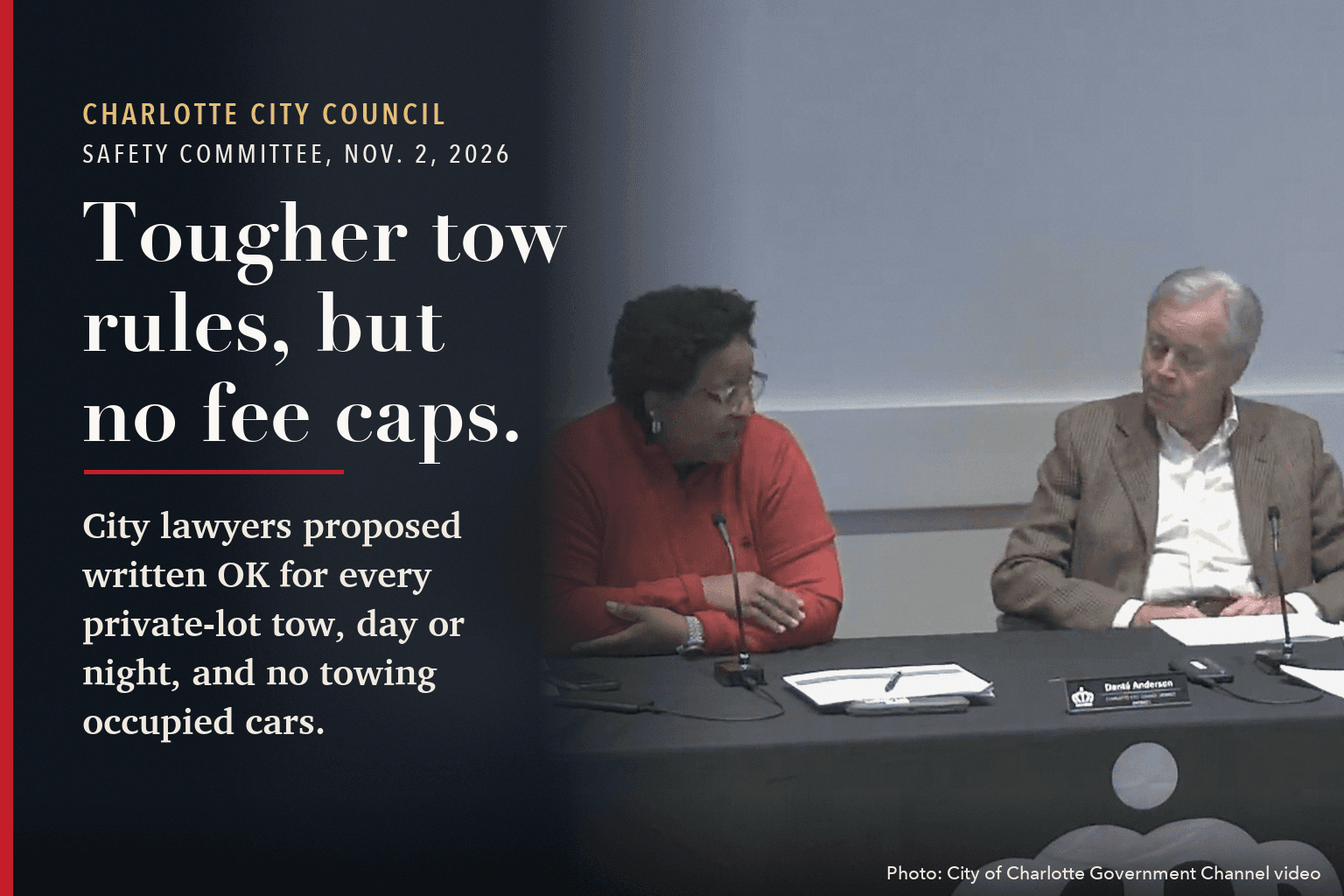
Tow trucks in Charlotte would need a property owner's written OK for that specific car before hauling it off a private lot at any hour, and could not tow a car with someone inside, under changes city lawyers proposed to a City Council committee on Monday. What the city cannot change, the lawyers said, is what many complaints are about: the fee.
Today the city's rule requires that written authorization only from 7 a.m. to 7 p.m. Making it round-the-clock "could help eliminate unnecessary tows or unauthorized towing on property," said Jessica Battle, a supervising assistant city attorney assigned to CMPD. Under current law, she said, nothing prohibits a tow truck company from towing a car with someone in it.
"The city does not have any authority under state law to set or determine fees and rates that tow truck companies should charge for towing or booting," Battle said.
None of the proposals is in effect. The council's Safety Committee did not vote. The chair, Council Member Danté Anderson of District 1, said, "I don't think we're quite ready to vote this out of committee," and that the item would come back on a later agenda. No date was set. It was the second time the committee had taken up the question and held it.
Why fees are off the table
The city attorney's presentation cites a 2014 decision of the North Carolina Supreme Court, King v. Town of Chapel Hill, which struck down local ordinances capping fees for towing and storing cars towed without the owner's consent. Battle said fee limits might be addressed if the council put the issue on its legislative agenda, its list of requests to the state. Those limits could include drop fees, the charge for releasing a car that is hooked up but has not left the lot.
When the committee first took up towing, on Oct. 5, Anderson closed the discussion by saying, "And we've seen the stories of our residents being charged $1,100 and upwards of towing that has been predatory."
What crosses the line, and what doesn't
What the city can address, Battle said, are practices that cross the line. Her office listed fees that climb when a driver objects, refusals to drop a car that has not left the lot, refusals to let people get their belongings out, and fees for calling police. Battle said some towing lots post signs saying people will be charged a fee if they call police, and that the city attorney is working to address them.
Other things drivers complain about are legal, the office said: booting without a warning or grace period where signs are posted, and tow drivers carrying guns. "No one wants their vehicle towed," Battle said, and officers at tow disputes sometimes find more than one person armed.
From Jan. 1 to Oct. 14, the presentation says, the city logged 31,109 calls for service about illegally parked vehicles and 2,103 calls classified as towing disturbances.
The rest of the proposals
The office's presentation listed five recommendations. Besides the round-the-clock written authorization and the ban on towing occupied cars, they are:
- Raise penalties for repeat violators. A violation of the city's towing ordinance now carries a civil penalty of $100.
- Require tow signs to list the drop fee and the number of a towing hotline if the city creates one.
- Consider putting predatory towing on the council's 2027 legislative agenda.
The office also said it was weighing whether to require tow companies to get a city permit and put decals on their trucks, as the city does for passenger vehicles for hire and dance halls. "Tow truck operators operate in Charlotte without needing any sort of business permit," Battle said. The city would have to decide which department ran a permit program and pay for the staff, she said.
Why members held off
Council Member Ed Driggs of District 7 said the occupied-car ban makes sense but could be abused: if a driver hops into a car as it is about to be towed, police would have to be called to remove them. "So I'm not sure about that one," he said. Anderson said a person riding in a car being towed also raises the risk of accidents, and she wanted to know whether the city could run a permit program before voting.
Council Member Kimberly Owens of District 6, who is not on the committee, asked whether a permit would let the city shut down a bad operator. Battle said it could be revoked, with an appeal to the city manager's office, as with the permits the city issues for dance halls and sexually oriented businesses.
Council Member Dimple Ajmera, who holds an at-large seat, asked staff to explore referring repeat offenders to the state attorney general's office.
How it got here
Mayor Rob Harrington sent the Safety Committee a referral, dated Sept. 3 on the committee's agenda, asking what more the council could do within its existing authority to protect people from wrongful tows and hold tow operators accountable.
On Oct. 5, the office made four of the same recommendations; the signage change is new. Driggs asked for data on tows and complaints and said he would probably not send the item out of committee that day. He said the $100 penalty looked like "a trivial cost of business." Battle later said, "sometimes that $100 is the cost of doing business that day."
What comes next
Council Member Malcolm Graham of District 2, who chairs the council's Budget, Governance and Intergovernmental Relations Committee, said that committee would probably look at making sure towing is on the legislative agenda. The draft state agenda staff showed that committee on Oct. 5 included a "clarifying amendment regarding commercial booting and authority to address nonconsensual towing issues."
That committee is scheduled to meet Thursday, Nov. 5, to consider staff's top three to five legislative priorities, with a vote if members want one, according to its agenda. The agenda does not say whether towing is among them.