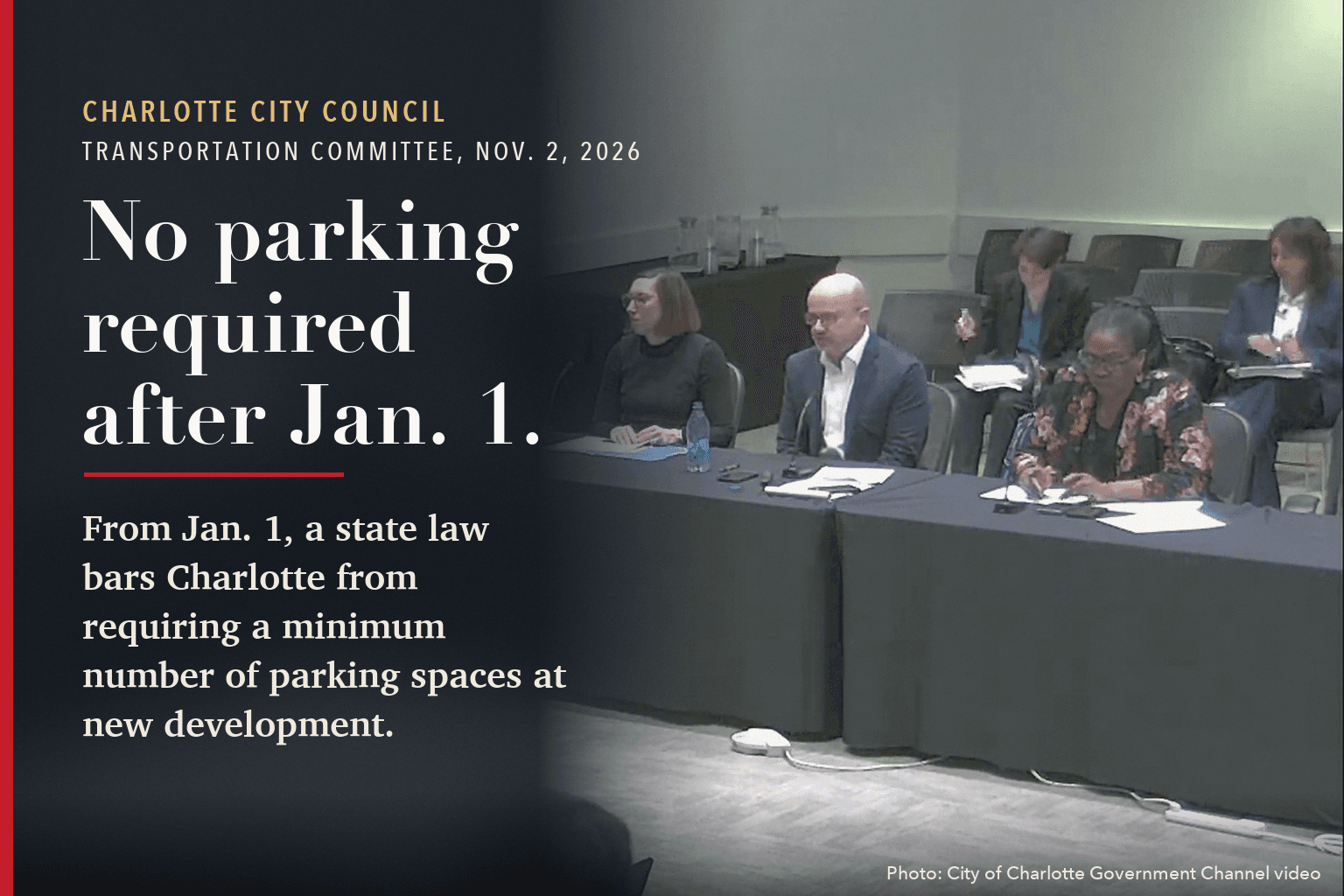
Starting Jan. 1, a new apartment building, store or office in Charlotte need not come with any parking at all. A state law taking effect that day bars Charlotte and most other North Carolina local governments from requiring a minimum number of off-street parking spaces for a development, and city planners are rewriting Charlotte's zoning code to match.
A city planning official told a City Council committee Monday that, from what other cities have seen, ending the requirements has probably done more good than harm. "It does result in additional housing being built. It does result in lower rents because your developers are spending less on parking spaces, which are quite expensive," said David Hittle, deputy director of the city's Planning, Design and Development Department.
What it means for the people living next door is less clear. Hittle called spillover parking on public streets "probably the biggest concern" about ending the requirements, known as parking minimums. "There's not been a lot of study as to the actual effects in that regard," he said. Cities that have dropped their minimums, he said, do not report many complaints and tend to look hard at how they manage parking at the curb.
Developers who do build parking must still follow the city's rules for it. Charlotte's caps on how many spaces a project may have, and its design standards for size, landscaping and maneuvering room, stay as they are, Hittle said. Bicycle and electric-vehicle parking requirements do not change either.
The rewrite, a zoning text amendment numbered 2026-078, changes the wording of the code itself rather than the zoning of any one property. It came to the council's Transportation, Planning and Development Committee on Monday as a briefing, and the committee took no vote. The city's presentation schedules a public hearing before the full council Monday, Nov. 16; a review Tuesday, Dec. 1, by the Planning Commission's Zoning Committee, which recommends whether the council should approve it; and a council decision Monday, Dec. 21. The parking law's effective date is set by the state, not by that vote. "It sounds again like we don't have a lot of choice," said the committee chair, Council Member Ed Driggs of District 7.
What other cities found
Asked by Driggs whether anything in the package should go on the council's list of requests to the state legislature, Hittle said the parking change looks "benign, neutral to positive" in cities that have already made it.
Hittle cited a study from UCLA of 12 cities that dropped their minimums. He said parking changed little overall, while new buildings in denser, mixed-use areas and areas built around transit came with fewer spaces, and in some suburban shopping areas parking increased.
The other four laws
Hittle called the parking section "arguably the most consequential" of the changes. It comes from Session Law 2026-39, one of five state laws the rewrite brings into Charlotte's Unified Development Ordinance, or UDO, the city's main zoning rulebook, according to the city's presentation. Most of the others are already in force; the rewrite brings the code's wording in line with them.
- Storefront glass. Since Oct. 1, under Session Law 2026-59, a city may not require more than 35 percent of the street-level wall of a commercial or mixed-use building to be windows or other glass, or more than 20 percent for space used for things like medical offices, houses of worship or storage. Charlotte's current requirements run "anywhere from 30 to 60 percent," depending on how you look at it, Hittle said.
- Homes on old commercial land. The same law requires the city to allow housing by right, with no rezoning, when land zoned for commercial, business or light industrial use is redeveloped. Hittle said the state's definition of redevelopment covers almost anything but a never-built-on field, down to a lot that once held only a concrete parking pad. Heavy industrial land, and contaminated sites not yet cleaned up, are excepted. New housing there would have to meet the standards of the residential district that most closely matches it, he said.
- Backyard cottages. Under that law, as of Jan. 15, a city that caps the size of an accessory dwelling unit, a small second home on the same lot as a house, may not set the cap below 800 square feet or above 1,000.
- Home businesses. Under Session Law 2026-51, the city can no longer require a zoning permit for a home business that meets the state's conditions, among them that it generates no on-street parking and no substantial increase in traffic. "If you teach piano lessons in your home, technically you're supposed to have a permit," Hittle said. That is no longer required.
Under Session Law 2025-39, the 2025 state law behind the new regional transit authority, the rewrite swaps the code's references to the Charlotte Area Transit System for the Metropolitan Public Transportation Authority. And under this year's state budget, Session Law 2026-41, a property owner who disagrees with a zoning decision by staff can now go straight to Superior Court instead of first appealing to the city's Board of Adjustment, a citizen panel that hears zoning appeals. The same law lets a petitioner choose whether old or new rules apply to a rezoning when the rules change mid-application.
'Things are happening in places we didn't intend'
Hittle called the housing provision "a little bit of a wild card" because it is written so broadly, but said staff probably would not recommend asking the legislature to change it. "It's just sort of not the way that the world works," he said of single-family homes going up on industrial land.
Driggs was less sure. "I mean, to me, that does potentially undermine our attempt to sort of guide the direction of the city, right?" he said, explaining that "things are happening in places we didn't intend according to our ordinance and over which we have no control."
Council Member Malcolm Graham of District 2, who chairs the council's Budget, Governance and Intergovernmental Relations Committee, said that committee would settle its recommendation for the council's 2027 legislative agenda at a meeting later this month, "so now would be the time" for a request. No member asked for one on Monday.
Council Member Kimberly Owens of District 6, who is not a member of the committee, asked about the cottage rule. She said the cottage plans the city has approved do not fit the new range. "I'd really like to see us move with all deliberate speed to put out some plans," she said. Deputy City Manager Rebecca Hefner said she would pass that along to the city's housing staff.
What comes next
Planning Director Monica Holmes said the city now bundles zoning code changes into two updates a year, and that the next is scheduled for spring 2027. She named electric-vehicle charging stations and manufactured housing as topics staff are researching.
The city's presentation lists two online information sessions on the parking rewrite, Thursday, Nov. 5, and Tuesday, Nov. 10, before the Nov. 16 hearing.