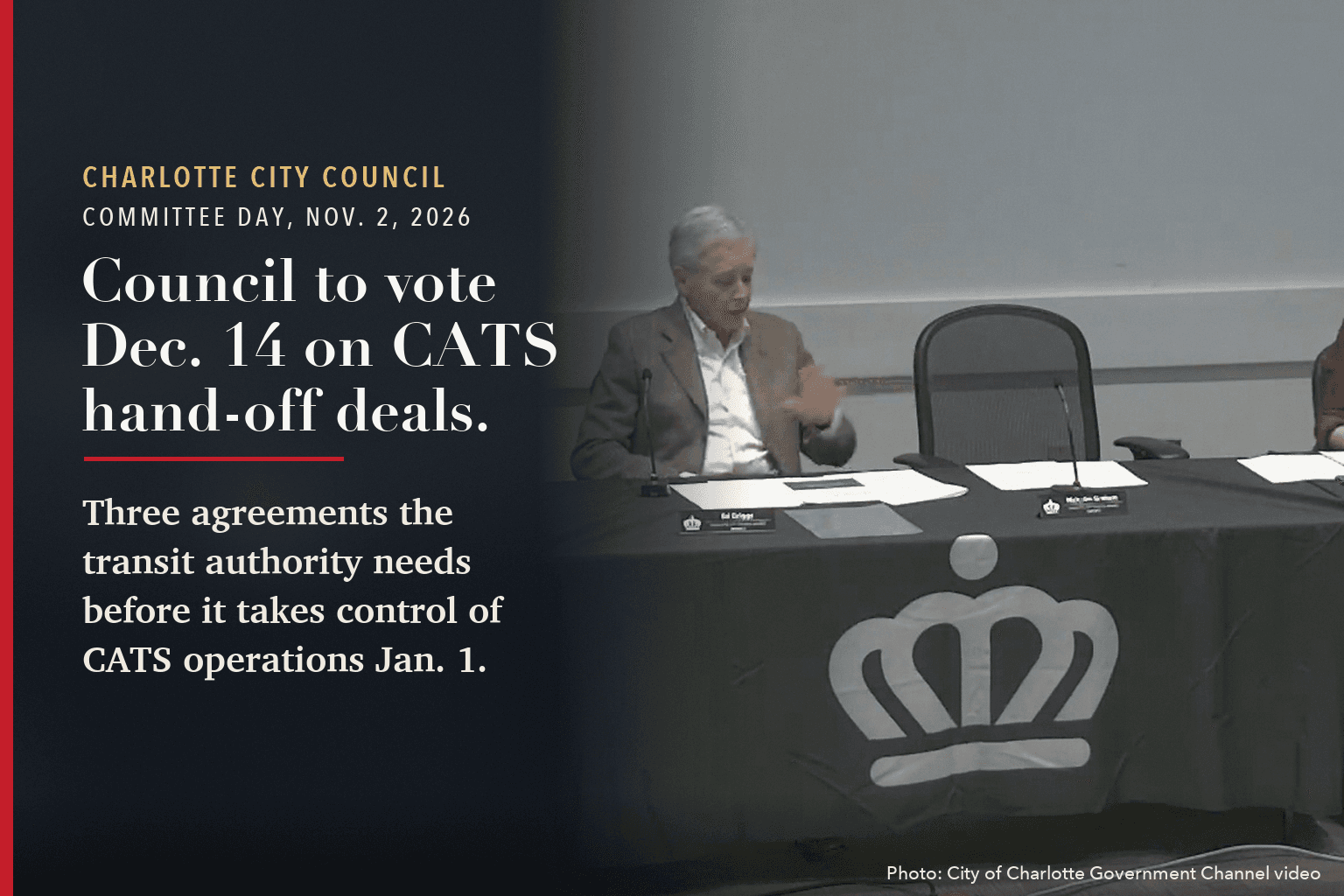
Charlotte City Council is scheduled to vote Dec. 14 on three agreements the regional transit authority needs before it takes control of CATS operations on Jan. 1. The authority's board is aiming for its own final vote Dec. 9.
One agreement would let the authority use the Blue Line and other assets that must stay in the city's name. Another would cover property the city and the authority both have a stake in, such as the bus maintenance facility on Davidson Street. The third would keep some city services going until the authority can line up its own.
City lawyers laid out the agreements and the schedule for a council committee on Monday, Nov. 2. Council members are to get a preview Nov. 23 and office hours on the agreements Nov. 30 through Dec. 11. The board's date is from the authority's committee packet.
The same committee heard that the city's exclusive deal with the developer of Gateway Station, the planned uptown rail and bus hub, runs only through Dec. 31. In other committee meetings that day, one committee left the rules for the city's nonprofit funding alone so the next round of applications can open this month, the city attorney said state law bars Charlotte from requiring its contractors to pay a living wage, and the police chief gave new crime numbers.
Handing CATS to the authority
The Metropolitan Public Transportation Authority, or MPTA, took control of CATS under state law on July 1 but has had the city keep operating it until the authority is ready. On Jan. 1 the city employees who work for CATS are to become authority employees.
Deputy City Attorney Lina James and Catherine Clodfelter, an attorney representing the city in the transition, explained the agreements to the Transportation, Planning and Development Committee. Assets such as the Blue Line stay in the city's name on paper because they secure city debt or carry grant restrictions, so the authority needs the city's permission to use them. At the Davidson Street facility, the city owns the land and the authority owns the facility. Under the services agreement, the city's transportation department, for example, would keep making bus stop signs until the authority hires another vendor or through June 30, 2027, whichever comes first.
Council Member Reneé Johnson asked about tenants in transit parking garages; the city's lawyers said those contracts are to pass to the authority and the tenants would presumably continue on their current terms.
Gateway Station waits on the authority
The city has extended its exclusive agreement with Charlotte Gateway Partners, the private developer it picked in 2020 for Gateway Station, through Dec. 31, the day before the authority is to take control of transit operations. Deputy City Manager Alyson Craig said inflation, interest rates, construction costs, tariffs and a wave of new apartments have left no certain timing for private development there. Staff plan to spend the coming weeks and months meeting with the authority's committees and board about how the two can partner on the project.
Council Member Ed Driggs, who chairs the committee, suggested the agreement could conceivably be extended again if circumstances warrant, and said no decision was about to be forced on the council.
The nonprofit money
Charlotte nonprofits that want city money for the year that starts next July are to get their application this month, under the same funding policy as last year but with a different kind of review. Instead of scoring each application for the council, city staff are to recommend which groups to fund and say why.
The city calls these groups its financial partners: nonprofits that apply each year for city money and, if chosen, get a contract with the city. In the last round, 39 applications asked for more than $6 million, and at a June 1 budget meeting the council sent the program to its Budget, Governance and Intergovernmental Relations Committee for review, according to the committee's agenda. On Monday, that committee agreed to leave the policy alone so the application can open, and to judge the new review once this round is done. It decided by voice vote, with no count taken. Minutes have not been posted.
Applications are to close in January and be evaluated by staff in February, and the groups chosen would appear in the proposed budget in May, with contracts beginning in July, according to the city's presentation. Cherie Smith, who manages the program in the city's Strategy and Budget office, told the committee the new application asks more pointed questions about who a group serves and what it will measure, and asks how its work advances plans the council has adopted, such as the 2040 Comprehensive Plan. A panel of staff from several departments is to review the applications. A second information session is to be held online Nov. 18.
"I do not believe at this time we should make changes to the policy," Smith said. Staff would rather run the new process first and bring any policy changes back in June, according to the presentation.
Council Member Dimple Ajmera said the timing mattered because many organizations depend on the money as other funding, especially federal funding, has dried up.
What the city can't require on wages
The budget committee also took up a referral from Mayor Rob Harrington, made Sept. 3, asking whether city contracting can favor businesses that provide "sustainable employment." City Attorney Andrea Leslie-Fite said North Carolina law bars a city from requiring private employers to pay a living wage as a condition of a city contract, and from using a lease or contract to set or influence wages, benefits or other terms of work for private-sector employees.
"We can't mandate wages," said Deputy City Manager Monica Allen. Staff listed what the city already does instead, including pushing contractors to pay subcontractors quickly and giving credit for workforce programs on construction projects where it picks builders by their qualifications.
Ajmera asked staff to look at "how can we use competition as a tool to incentivize a livable wage," pointing to a cleaning contract at the airport. Mayor Pro Tem James Mitchell Jr. said the referral grew out of a problem at the airport and asked staff to narrow the work to city-owned facilities. Staff are to bring back options.
The crime numbers
Charlotte-Mecklenburg Police Chief Estella Patterson told the council's Safety Committee that violent crime is down 14 percent from last year, that homicides are "slightly up," 79 against 78 for the year, and that the department has "a 76 percent clearance rate." She did not say what date her count ran through.
The department's third-quarter report, which showed a 17 percent drop, covered overall crime, violent and property offenses combined, from Jan. 1 through Sept. 30. Violent crime alone was down 15 percent in that report, and homicides stood at 66 against 60.
84 small businesses, 830 certified firms
HIIVE, the Hub for Inclusivity, Innovation, and Entrepreneurship, a nine-week program at the Market at 7th Street for food and retail businesses, is to have 84 graduates when its fourth class finishes Dec. 16, James Labar of Charlotte Center City Partners told the Economic Development and Workforce Committee. He said the city granted $250,000 three years ago to build the program's kiosk and curriculum and paid for its first two classes. The 84 businesses report $6.83 million in annual revenue and 211 workers, according to the program's one-page summary given to the committee.
The city also had 830 firms certified as small business enterprises as of Oct. 19, up from 805 in August, according to staff. Certified firms count toward the small-business goals the city sets on its contracts. The program is race- and gender-neutral; a state law that took effect July 1 ended local minority- and women-owned business programs, and the council adopted its revised policy Oct. 26.