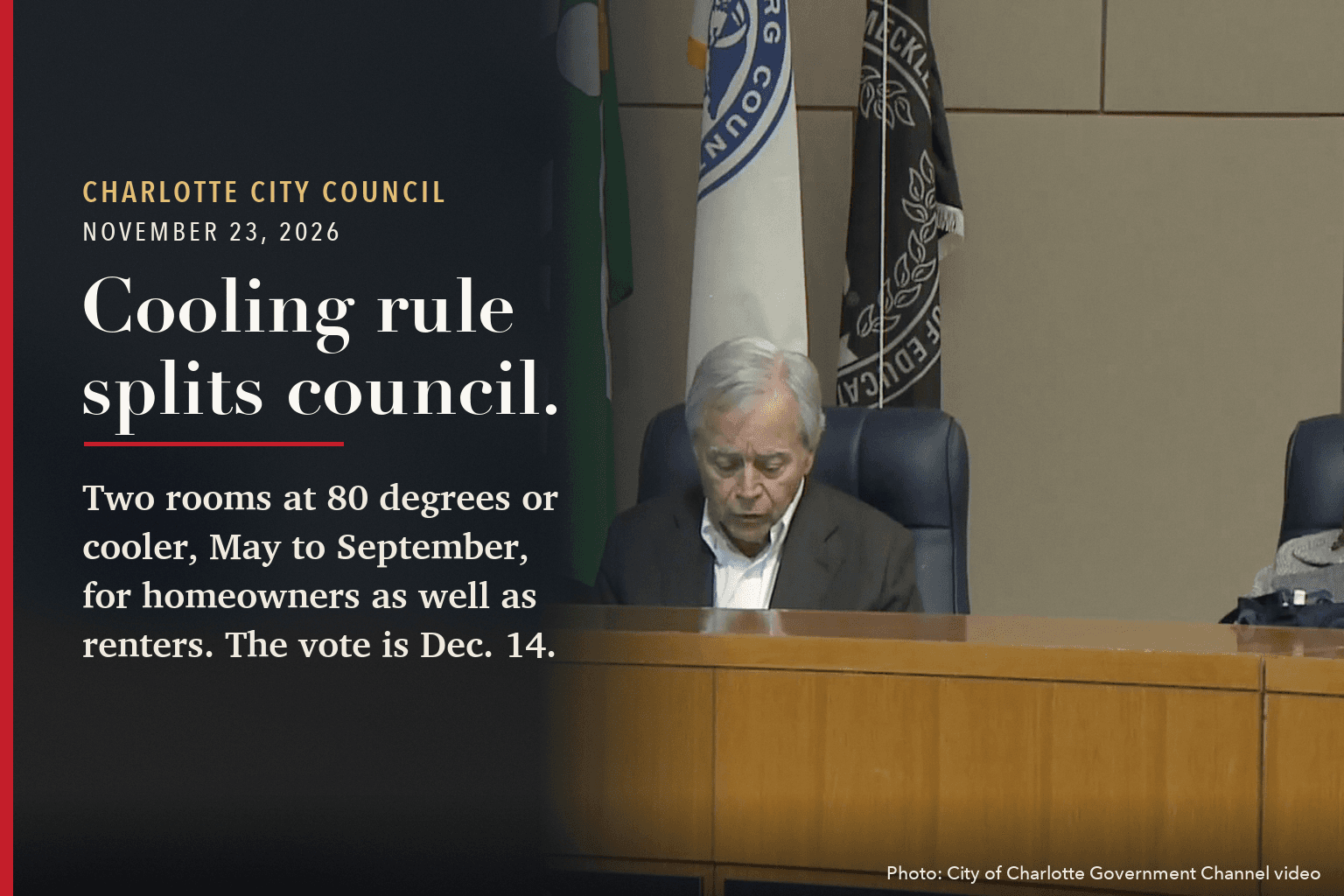
City Attorney Andrea Leslie-Fite told the Charlotte City Council on Monday that a proposed air conditioning rule would have to cover people who own their homes, not just renters. Several council members questioned what the rule would cost and how far it would reach, and Council Member Ed Driggs said, "I'm not ready yet to support this."
The rule, up for a public hearing and a vote Dec. 14, would require every home in the city to have cooling that can keep at least two rooms at 80 degrees or below from May through September. City staff pointed to hotter summers: Mecklenburg County activated its heat plan on 20 days this year, up from 12 extreme heat days in 2025, and staff listed seniors, children and the medically fragile among vulnerable residents.
Council Member Dimple Ajmera asked what the rule would mean for one constituent, an 80-year-old widow who has owned her home for 40 years and could not afford to replace her broken air conditioner last year. "So under this ordinance, what happens to her?" Ajmera asked. The widow would most likely be referred to the city's urgent repair program, said Warren Wooten, deputy director of Housing and Neighborhood Services. Ajmera then asked whether staff had studied what the rule would cost older homeowners on fixed incomes. They had not.
Mayor Pro Tem James Mitchell Jr., who supports the rule, urged colleagues to find six votes on the 11-member council: "Let's make sure on December 14th we can get six hands to move forward."
Driggs warned that the cost would probably land on the lowest-income residents through higher rents. Council Member Reneé Johnson, a member of the Housing Committee that sent the rule forward, said the support came with a caveat: "What I supported is to move forward, but to take a look at being able to carve out exemptions for owner-occupants." Council Member Danté Anderson asked why, with the city's aid programs continuing, the code needed to change for the roughly 3,100 homes the Census Bureau estimates lack air conditioning, "less than a percentage point of population in our city."
What would change
The estimate does not separate renters from owners. Today the housing code requires only that cooling equipment already in a home be kept working. Under the new rule, broken cooling in the hot months would be an "imminently dangerous" condition with 48 hours to fix it, the same window the code gives broken heat. A window unit would satisfy it, owners working on a repair could get more time, and fines of $100 a day could not start for at least 60 days. If the council passes it, the rule would take effect in May 2027.
Inspectors would not go looking for violations in owner-occupied homes, staff said, but could not ignore one they found while there for something else. Most complaints come from tenants.
Because the rule rests on the city's power to protect health and safety, it would override homeowners association bans on window units. It could not stop rent increases: state law bars Charlotte from regulating rents, so landlords could pass the cost along.
The case for it
The city and Mecklenburg County have given out more than 200 window units in the past two years without turning anyone away, though the city does not install them or help with the electric bill. Council Member JD Mazuera Arias called the rule "an extra cushion to ensure that we are keeping our most vulnerable safe." Council Member LaWana Mayfield, who chairs the Housing Committee, said the council could set aside $500,000 of the city's leftover federal pandemic relief money for repairs, and argued that the rule should go straight to a vote rather than back to committee.
Council Member Kimberly Owens likened the debate to the one over requiring indoor plumbing. "I am surprised that in 2026 we as a council are debating whether humans should have a minimum living standard that enables them to sleep at night," Owens said.