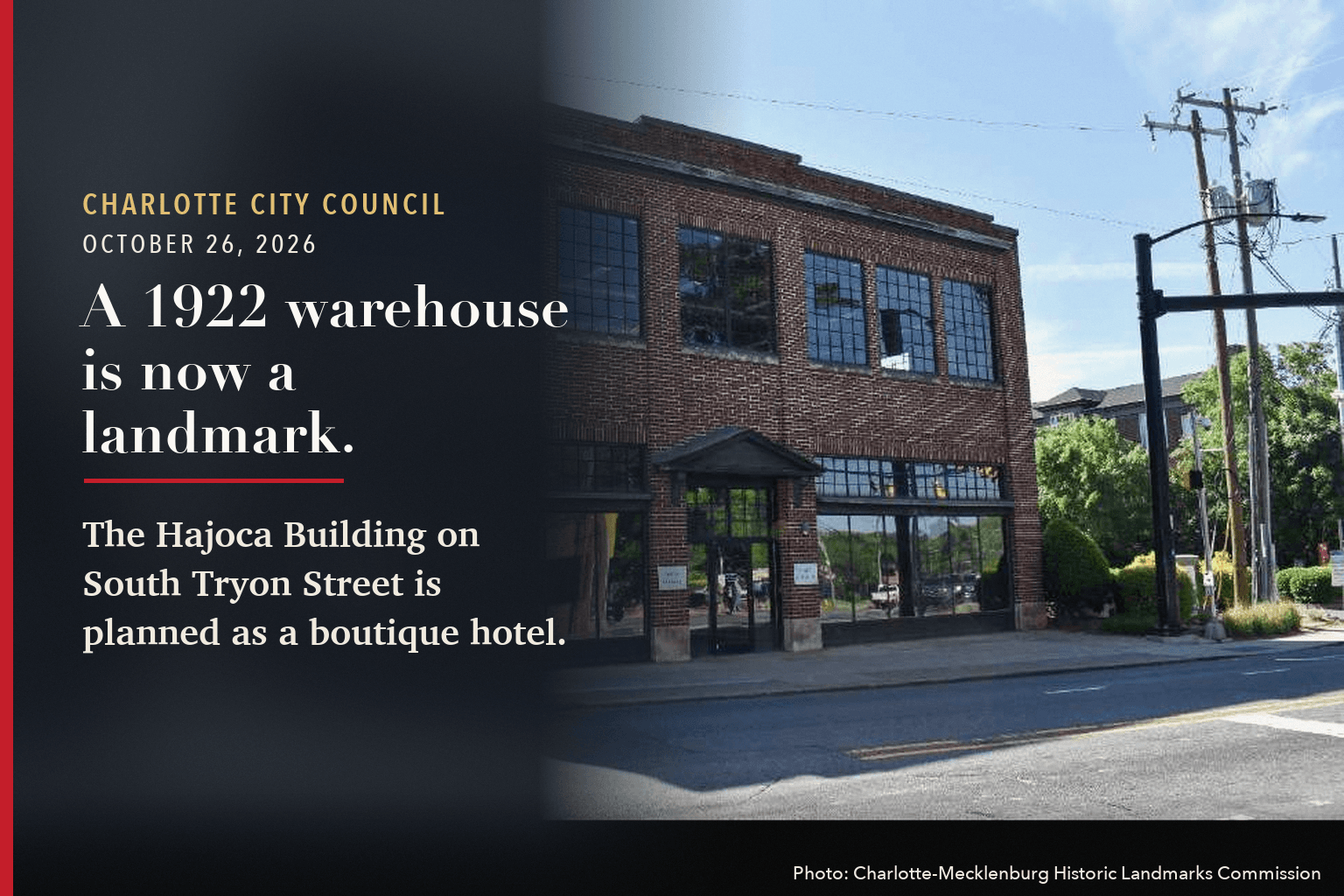
A 1922 brick warehouse on South Tryon Street, built for a plumbing supplier and headed for a second life as a boutique hotel, became a Charlotte historic landmark Monday. Its owner can now defer half its property taxes, about $28,300 at the building's current value.
That was the problem for Council Member LaWana Mayfield. With amendments on the Nov. 3 ballot that could limit property taxes, Mayfield questioned why the city would take that money off the tax rolls now.
“I am going to be a no because we need to have some very real conversations about what the financial potential impact will be if this community supports these recommended amendments.”
LaWana MayfieldCharlotte City Council, At LargeVideo: Charlotte Government Channel
The tax question
Landmark status lets an owner defer half the property tax, as we explained in September. The deferred tax is not forgiven; it is carried as a lien on the property. For the Hajoca Building, at 1447 South Tryon Street, the city's agenda put the deferrable taxes at about $10,559 for the city and $17,756 for Mecklenburg County.
No city staff member stepped forward when Mayfield first asked why the building qualified. A representative of the building's ownership group came forward but had not signed up to speak at the hearing and was not allowed to answer. The city attorney said members could put questions to the owner; asked by Mayfield, the attorney said hers was best directed to city or county staff.
Chief Financial Officer Matt Hastedt, speaking generally rather than about this project, later told council that because landmark deferrals are council policy, they are built into the budget when it is adopted. The finance office is watching the ballot measure, Hastedt said, but cannot yet estimate what it would do to the budget.
Council Member Ed Driggs of District 7 said the city should "adhere to our existing policies until and unless this action passes." Council Member JD Mazuera Arias of District 5 thanked Mayfield for raising the issue, calling it "a standard economic practice for developers to seek a historic landmark designation" to win tax incentives, but said he would support this one.
At-large Council Member Dimple Ajmera said a council committee should weigh what all of the city's incentives, not only landmark deferrals, would cost if the tax amendment passes. At-large Council Member Victoria Watlington asked staff to look at every property in the city that could qualify, saying many members have said they don't want to decide them "on a parcel by parcel basis."
Council Member Joi Mayo, whose District 3 includes the building, pointed to the Court Arcade on East Trade Street, which she said was demolished and is being turned into a data center. "We were only able to do so much because it did not have the historic designation," she said. Council Member Danté Anderson of District 1 also cited the arcade.
Mayor Rob Harrington declared that the designation passed. He did not read a count, and the city had not posted minutes of the meeting as of Tuesday morning.
Why the building
The Charlotte-Mecklenburg Historic Landmarks Commission recommended the designation. The commission says Charlotte architect Louis H. Asbury, North Carolina's first native-born professionally trained architect, designed the building for Hajoca, a national plumbing and building supplier. It went up in 1921 and 1922 beside the Southern Railway tracks, which now carry the LYNX Blue Line.
Tommy Warlick, a historic preservation specialist with the county's Historic Landmarks Department, told council that none of Asbury's commercial buildings remain uptown. The Hajoca Building's concrete and hollow tile construction was something the department had never seen in Mecklenburg County, Warlick said, and staff called in the state historic preservation office to identify it.
The interior was turned into office suites in a renovation permitted in 2004, according to the report. Warlick told council the building is planned as an upscale boutique hotel, and that the developer has been receptive to finishing the interior so the original construction materials stay visible.
From now on, changes to the exterior, and to the parts of the interior named in the designation, need the landmarks commission's approval, called a certificate of appropriateness. An owner who goes ahead without it loses the deferral and the landmark designation and repays the prior three years of deferred taxes, Warlick said.
An annexation, and the River District
Minutes later, council annexed 13.092 vacant acres on the east side of Dixie River Road, south of West Boulevard, adding them to the city and to Council District 3, the Hajoca Building's district. The site is part of the River District development, and the agenda says it is planned for commercial and retail space.
Mayfield said the River District project began while she represented District 3, and that council's support rested on verbal agreements about housing at a range of prices, but "none of that language was incorporated." "There is little to no mixed income housing where the workers that will be in the River District or even at the Charlotte Premium Outlets have access to the housing," she said, and she asked that her concerns be noted for the record. Harrington declared that the annexation passed, again without a count.
Council set Monday's hearing in September with Mayfield opposed. Charlotte's annexation policy, adopted in 2003, does not ask for affordable housing, and staff told council in September that asking could pose a legal risk.