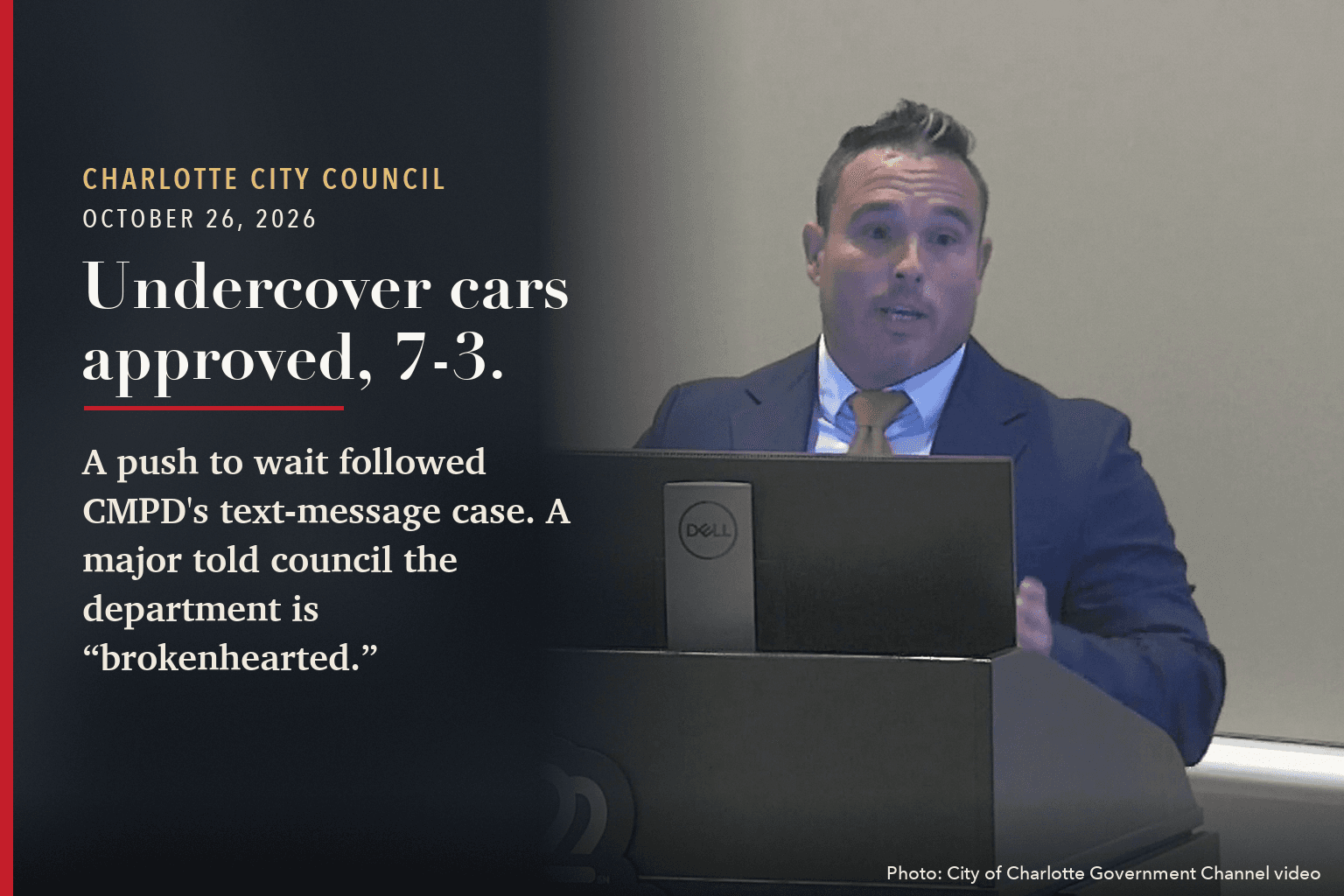
A week after Charlotte police named seven officers in a racially charged text-message case, the major whose bureau runs its undercover cars told City Council on Monday that rebuilding trust would take time.
"You know, we're brokenhearted. We are. And I can't stand here and tell you to trust me right now," said Maj. Stephen Fischbach, who leads the Charlotte-Mecklenburg Police Department's Special Investigations Bureau. "It's going to take time."
Council approved the bureau's new undercover cars anyway, 7-3, over a push to make the department wait. The four-year lease with Hendrick Automotive Group, arranged through a cooperative contract that public agencies share, is estimated at $625,000 a year, and the city manager can extend it.
The vote was by show of hands, and Mayor Rob Harrington declared that the motion "passes seven to three." Members' names were not read aloud, and the city has not posted minutes recording each member's vote.
The push to wait
Council Member JD Mazuera Arias pulled the item from the consent agenda, the list of routine business approved in a single vote. He cited recent events involving CMPD officers and analysts, and immigration enforcement in the community, and said council should have "a further policy discussion" about unmarked vehicles and how CMPD uses them.
CMPD released the names of seven officers tied to the text messages on Oct. 19. The department has not released the messages; Police Chief Estella Patterson has said they showed racial, sexual and religious biases. Six of the officers had resigned by the time of the release, and the seventh remained suspended without pay.
Council Member LaWana Mayfield said her larger worry was money. If the tax-limit amendments on the Nov. 3 ballot pass, she said, the city could have less access to property tax revenue, "of which 60% of our taxes go to public safety." She asked whether the contract could wait until after the election. A staff member said it could, and Mayfield moved to defer it. Council Member Reneé Johnson backed the delay.
Council Member Malcolm Graham said he would vote to defer to get more information, but he cautioned colleagues "to not co-mingle issues." "We all agree and understand that there's a cancer within the organization," he said, naming "the text messages, racism, hatred, and discrimination." Council still had to give officers "the tools necessary to be effective and efficient," he said.
What a 'burned' car is
Council Member Dimple Ajmera, who said she supported the deferral, asked to hear from CMPD. Fischbach said the bureau has 90 to 95 vehicles, about 25 of them "true undercover" cars with no lights or siren. Of those, 5 to 10 get "burned."
"Suspects have seen us use those when they get arrested, and now they know this make, this model, those wheels, that's an undercover vehicle," Fischbach said. The bureau needs to turn those in for fresh cars, Fischbach said.
Fischbach said the cars are used to take violent suspects into custody without a confrontational arrest, to investigate repeat shootings into occupied homes, and by vice detectives buying fentanyl from dealers.
Asked how long the bureau could wait, Fischbach said: "We can get by for a month."
The substitute
Council Member Ed Driggs answered Fischbach directly. "You can absolutely ask us to trust you," Driggs said. "This is an ordinary course of business request for equipment CMPD needs to carry out the policies that we have set forth for them. It's not an occasion to revisit those policies."
Driggs offered a substitute motion to approve the contract, saying council could then refer the use of the cars to a committee.
Council Member Danté Anderson backed it. "I'm going to trust the major," she said.
Johnson held to a 30-day delay, the time Fischbach had said the bureau could absorb, saying answers about the text messages were still outstanding. "I know the people that I've spoken to want to see more transparency from CMPD than less right now," she said.
"On behalf of District 6, I will not be supporting a deferral," said Council Member Kimberly Owens. "This for me is a function of equipment to do the job."
Ajmera then said she supported the substitute motion and asked CMPD to confirm for the record that it does not enforce federal immigration law. "No, we do not partake in immigration enforcement," Fischbach said. Graham said he would support the substitute, too.
The substitute passed, 7-3. No motion to send the use of the cars to a committee followed at the meeting.