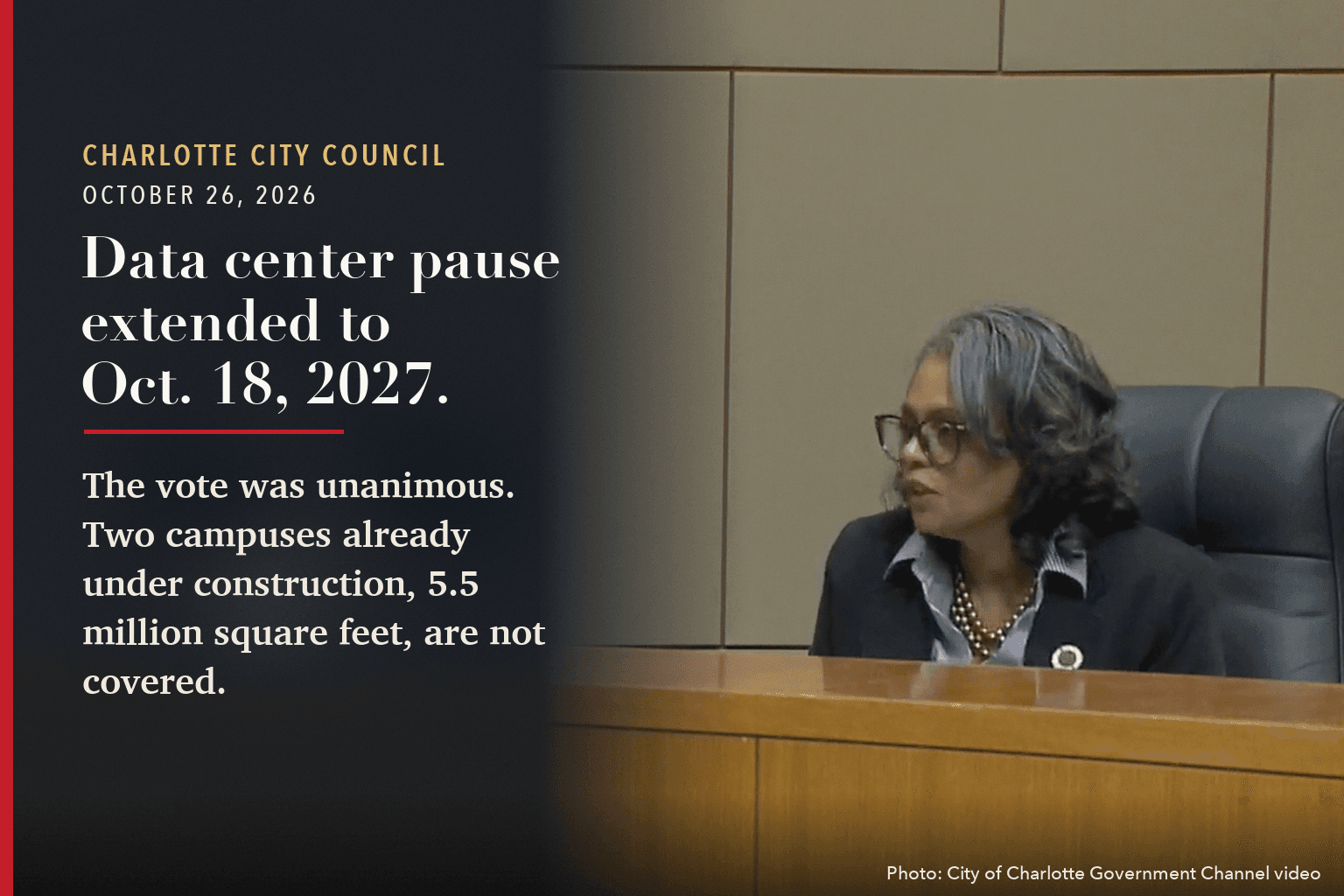
The two biggest data centers headed for Charlotte are already under construction, and the pause City Council extended Monday will not touch them.
Council voted unanimously to keep its moratorium on new data centers until Oct. 18, 2027, giving the city almost another year to study their effect on water, power and noise and to write rules for them. But the campuses off University City Boulevard and Moores Chapel Road, approved for up to 5.5 million square feet between them, won their rezonings before the pause began, and state law exempts them.
The pause, which was to end no later than Nov. 5, bars new data center applications in Charlotte and in the unincorporated area just outside it where the city controls zoning.
"I need to sound the alarm," Council Member Reneé Johnson said before the vote. "We have two hyperscale developments. It's actually 5.5 million square footage of data centers that are currently under construction that will not be subject to these provisions unless our city can find a way to make that happen."
No member spoke against the extension. After a show of hands, Mayor Rob Harrington declared, "We have unanimity." The city has not posted minutes of the meeting.
What the two campuses may still have to do
The exempt projects are Digital Realty's campus on Moores Chapel Road, approved for up to 3 million square feet, and the PowerHouse campus off University City Boulevard, approved for up to 2.5 million.
Johnson said council had learned that if the city adds requirements to its noise ordinance and other city ordinances, "we can require existing data centers to comply with that." Both campuses sit outside city limits, and the city has not said whether its noise ordinance, written for noise "in the city," would reach them, as we reported. How far the campuses sit from homes is another matter, she said. If the next 11 months show that data centers need a set distance from residential areas, Johnson asked, "what then do we do" about the ones already built?
She asked whether anyone in the room knew how close the two sites are to homes. Harrington said the only question before council that night was the moratorium and that council could return to her question later. Johnson asked that the answer be sent to the full council.
Council Member JD Mazuera Arias said he is "still 10 toes down on no data centers near residential areas." Later in the debate, Johnson took up his phrase: being that firm, she said, "means being willing to take a lawsuit."
What the extra year is for
Council adopted the 150-day pause June 8 so the city could study how data centers affect water, energy, noise and land use, and consider rules for them. Under state law, an extension requires good-faith work toward those goals and new facts that justify more time.
The agenda listed both. The work includes a data center impacts report from the World Resources Institute, a 19-member community task force and public meetings. The new facts, as the city put them: the institute's research shows data center impacts are "variable and complex," and staff and task force members say Charlotte lacks tools such as capacity verification, monitoring protocols and cooling standards.
City staff made the same case at an Oct. 12 public hearing. Not everyone there wanted the same length: several residents and a task force member asked for a longer pause, 32 months in some cases, and another task force member said the city did not need another year.
'A reactionary response'
Council Member LaWana Mayfield voted yes and said the city was late. Mayfield said she voted against the data center projects that came to council in 2023 and 2025, and that in 2023 she asked what the first would do to water and electricity.
"I also want us to be very clear this is a reactionary response, even though I'm glad we are finally here," Mayfield said. "This could have been addressed a number of years ago."
Council Member Kimberly Owens said she is not in favor of moratoriums generally because they create uncertainty for workers, businesses and property owners. The city's real limit, she said, is that it cannot downzone, or cut what an owner may build. A 2024 state law requires the written consent of every affected property owner. "I will support it tonight because I don't have another option," Owens said.
Council Member Dimple Ajmera, who sponsored the original pause, called the extension "a huge step forward towards responsible development."
Business and labor
Council Member Ed Driggs said Monday that "the business community is generally okay with it" and that there is "not a big pipeline of projects" for the pause to hold up. At the Oct. 12 hearing, Larry Shaheen, who described himself as a board member of the Commercial Real Estate Development Association, questioned whether an extension fits state law when the city may lack the authority to adopt the rules it is studying.
Seven union speakers addressed council at that hearing. Most asked for rules, not a ban, and one electrician asked council to lift the pause. On Monday, Council Member Danté Anderson said she is "very mindful" of the union that told council, the last time it took up the pause, that it was keeping jobs away from its members. Mazuera Arias said he was "conscious about the concerns that the labor unions have brought forward."
Mayfield disputed the jobs case. Building a data center takes four to six months, she said, and "it is not a job creator."
Waiting on Raleigh
Driggs pointed to two bills in the General Assembly, Senate Bill 730 and House Bill 1189, which he said are in committee and already have draft language that lines up "substantially with the concerns that we have." He suggested the city share its research with lawmakers. Anderson said she believes the General Assembly will move faster on the issue and welcomed the ordinance's "no later than" end date.
The pause can end sooner. Driggs said that if council settles on its policies before the deadline, it can lift the moratorium early. "So we're not locked into the duration of the moratorium," he said.