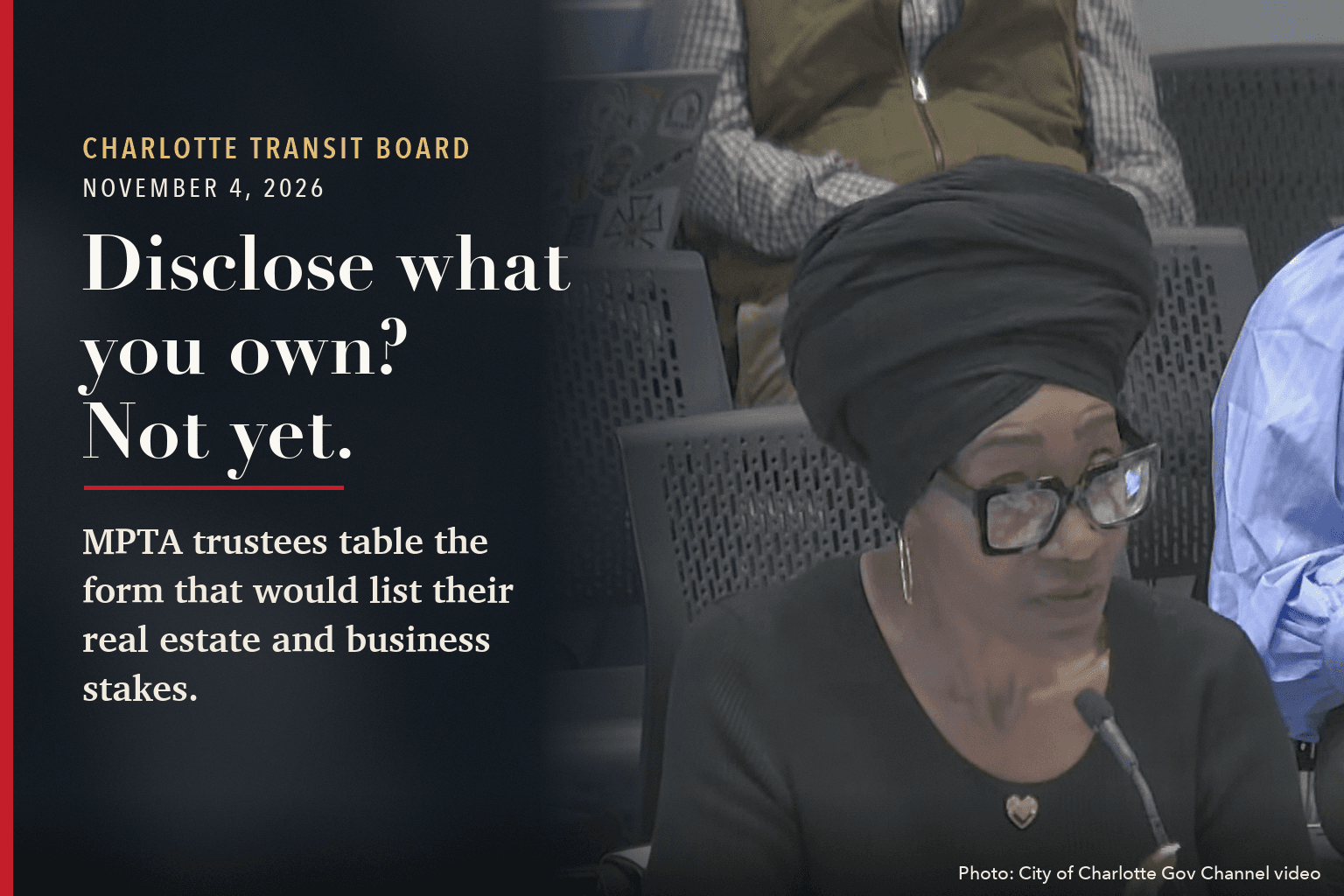
The trustees who took control of Charlotte's buses and trains in July are still working out how to disclose what they own. The form they have been drafting since then would have each of them list every piece of Mecklenburg County real estate they or their households own, down to their own homes, and any stake of 10 percent or more in a company that does or wants to do business with the transit system. On Wednesday, Nov. 4, they put it off again.
The argument ran both ways. Trustee Todd Collins said the form amounts to "effectively giving your personal financial statement as a matter of public record, which seems overreaching." Trustee Peter A. Pappas said it didn't go far enough: "I would think owning any percentage would be a conflict."
The Rev. Corine Mack moved to table it so the board could write language "more transparent and concise and clear." Chair David L. Howard asked trustees to send their thoughts before the executive committee meets Wednesday, Dec. 2, and said he wants the policy adopted in December "because we need to be ready in January," when the first statements would be due.
The Metropolitan Public Transportation Authority took legal control of the Charlotte Area Transit System, CATS, on July 1. Its trustees adopted an ethics code March 11 that requires each of them to file a yearly disclosure, on a form the board approves. Until this one passes, the board lacks "the forms required" by the code, the staff summary in the meeting packet says.
The packet says the form is meant in part to flag problems under North Carolina's criminal self-dealing statute. Brad Thomas, the general counsel for CATS, told the board that law can come into play when a trustee owns more than 10 percent of a property or business that is the subject of a deal with the authority.
The executive committee first discussed the policy July 22 and sent it to the full board, which took it up Sept. 10 and sent it back for more work. The committee recommended a revised version Oct. 28.
What the form asks
Each trustee would file a statement every January, covering the trustee, a spouse and family members who live in the household. It asks about any real estate they own in Mecklenburg County, with the address or parcel number and the share owned, which would include a trustee's own home. It asks about stakes of 10 percent or more in companies that do business with CATS or the authority, or whose finances the authority's decisions could affect. It also asks about jobs and board seats with such companies and with nonprofits.
James Cass of the Robinson Bradshaw law firm, one of the authority's outside lawyers, presented the policy. He told the board the statements would be a public record but would not be published. The board secretary or staff would keep them. A trustee could leave out information he or she is bound to keep confidential for someone else.
How it stalled
Pappas asked why the form needed the percentage owned at all, if the point was to disclose an asset that could pose a conflict. Cass said the figure helps judge whether a stake matters, and Thomas cited the 10 percent line in the self-dealing law.
Trustee T. Anthony Lindsey objected to two other parts. One lets the presiding officer split a motion so that as many trustees as possible can vote when some have stepped aside; Lindsey said the board gets no chance to debate such a split. The other is wording he read as putting the new policy ahead of the ethics code. "I would be opposed to those things without change," he said.
Trustee David Longo thanked the lawyers for taking up concerns he had sent them and suggested a simpler box: do you own more than 10 percent, yes or no. That way, he said, "people might not feel like they have to disclose their full interest." Cass said a box would satisfy the statute, but "keep in mind that the point of the form is disclosure. So generally speaking, more disclosure is better than less disclosure." Mack, who had pulled up the state's own ethics form, said it already asks for a percentage of ownership in property. Longo dropped the idea.
Mack then made her motion. "We have a community that we're building trust with, and we have to shun the very appearance of evil all times," she said.
Pappas came back to the percentages. He asked what difference it makes whether a trustee owns 5 percent or 75 percent, said he would disclose even a 1 percent stake, and proposed a substitute: ownership at any percentage would count as a conflict. Cass reminded the board that the disclosure policy does not define a conflict at all. The ethics code does, case by case, with no percentage test.
Collins said the board had started from a simpler idea: a trustee with a conflict would step aside. If trustees were going to have to make their finances public, he said, they should have been told when they were vetted for their seats.
The substitute was withdrawn, and the board took up Mack's motion. Howard said his only request was that trustees come back with "substantive stuff" so the board was "not deferring to defer. Because I don't want us just to kind of get around hard stuff." He told Collins the board had talked about a disclosure policy since it started, and said that if Collins meant the board should go without one, he doubted that was good practice. Collins said he didn't. He said he was fully behind a disclosure policy. "I don't think it should be overreaching, though."
The motion to table passed by voice vote, with no count taken. The chair also put off two other policies, on delegation of authority and on technology devices, without a vote.
The same night, the board heard the schedule for the authority's about 48 service agreements with the city, to be in place by Jan. 1, when CATS workers, still city employees until then, move to the authority: authority committees Nov. 18, the executive committee Dec. 2 and a board vote Dec. 9, ahead of City Council's Dec. 14 vote. The full meeting video is on the CATS channel.