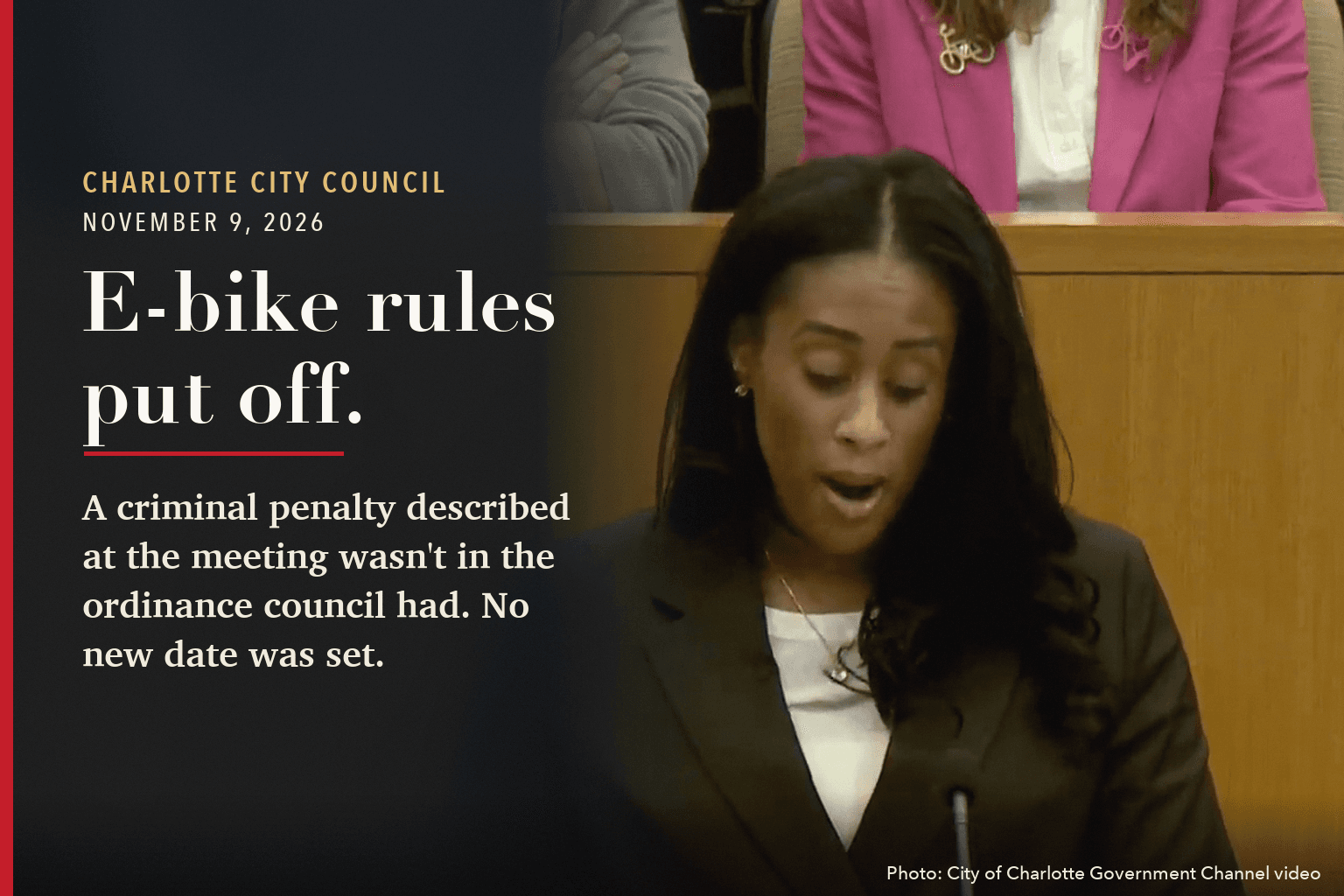
A city lawyer told Charlotte City Council on Monday night that its new e-bike rules would make it a crime to damage property while riding one. The ordinance in council members' packets said no such thing, so council put the rules off.
That ordinance, as the city published it for the meeting, sets only a $50 civil fine for riding an e-bike in a way that damages public or private property. Jessica Battle, a supervising assistant city attorney who presented the rules, had described the charge as a Class 3 misdemeanor. Some revisions may have been made, she said, and something may have been cut off.
Any change to the ordinance the city had published could pass that night only by a two-thirds vote, City Attorney Andrea Leslie-Fite told council. Mayor Rob Harrington said council could technically add the penalty and vote, "but that's probably a bridge too far." No new date was set.
That holds up the rest of the plan city staff laid out two weeks earlier: helmets for riders and passengers under 16 on Class 1 and Class 2 e-bikes, the kinds whose motors stop helping at 20 mph, and a white front lamp and red rear reflector on every e-bike at night. The state law that sorts e-bikes into those classes takes effect Dec. 1.
Some members doubted the criminal charge before anyone noticed it was missing. "I don't know that I support the criminalization," said Council Member Reneé Johnson, who said restitution could come through a civil case instead. Battle said a criminal case lets a judge order a rider to pay for damage without the victim filing a lawsuit.
Council Member Kimberly Owens asked that riders yield to pedestrians on every sidewalk; the published ordinance requires it only on sidewalks narrower than 5 feet.