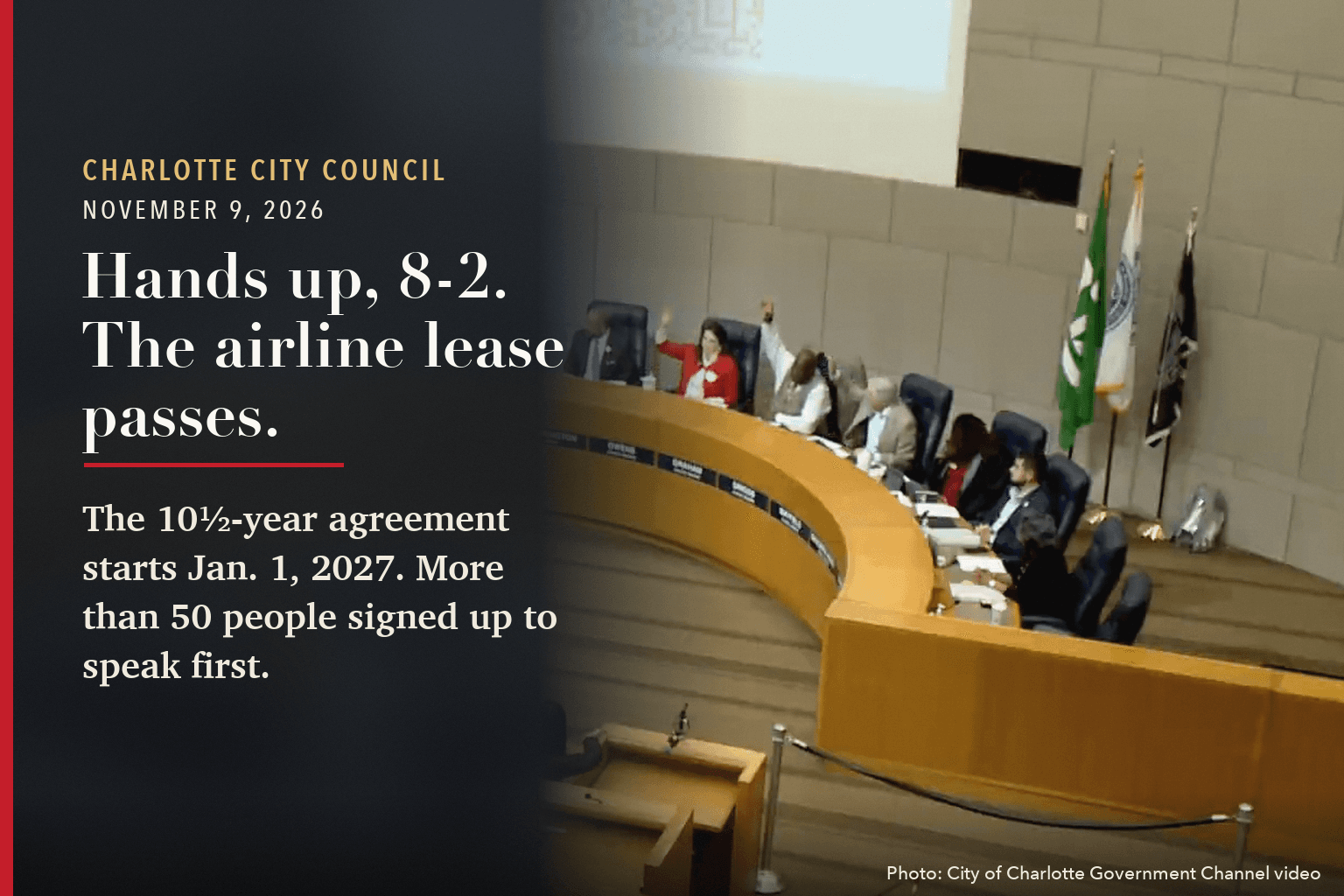
American Airlines already holds 93 of the 123 gates at Charlotte Douglas International Airport. Under the lease Charlotte City Council approved 8-2 Monday night, it will get every gate in the coming Concourse C expansion, too. Wheelchair attendants who told council they make $12.50 an hour had asked it to wait.
Here is how the vote went:
Ajmera, Mayo, Owens and Watlington had voted in October to take until Nov. 23 to decide, as had Mazuera Arias and Johnson. Mayor Rob Harrington vetoed that review, and Monday's vote came two weeks sooner.
The lease sets the airlines' rent, gates and building plans from Jan. 1, 2027, through June 30, 2037. An airline that signs it approves $1.72 billion of a $2.12 billion construction list, led by the $700 million Concourse C expansion.
If American doesn't use the new gates enough, the city can take them back, the airport's chief executive, Haley Gentry, told council: "Our agreement gives us the right to recoup those gates." She added that it would be "very difficult" for another airline to operate in the middle of American's hub.
Once the new gates have been open a full fiscal year, they face the same minimum-use rule as every other gate: on average, 5½ turns a day per gate (a turn is one plane arriving and departing) or 675 seats a day per gate. The city needs no airline's consent to take back gates that fall short, and it keeps 17 of the 123 gates for any airline to use as needed.
What else is in the lease
The airlines' share of certain leftover terminal revenue rises from 40% to 45%, leaving the city 55%; the split had been 60-40 since the original 1982 agreement. An airline that signs by Dec. 31 gets a one-time share of any terminal revenue left over from fiscal 2026.
The lease can run five more years, to June 30, 2042. Any airline that approves certain large building projects, such as a gate project of at least $500 million, gets the extra years automatically, and other airlines can join. Near the end of the term, the city can also offer the extension on its own; it takes effect only if airlines landing most of the airport's traffic accept, and only for the airlines that do.
Business said yes; workers said wait
More than 50 people had signed up to speak. Business groups, hospital systems, hotel owners and airport shopkeepers asked council to approve the lease. Wheelchair attendants, plane cleaners and escorts for children flying alone, all working for American's contractors, asked it to wait, and so did 32BJ SEIU, the union organizing the wheelchair attendants.
Many of the workers had gone home before the vote. Quite a few "have been together since 3 o'clock this afternoon, so they needed to head out," Mayfield said.
City attorneys have told council they believe state law bars the city from using the lease to set wages or benefits for airline and contractor workers. "We do not have the legal ability," Mayfield said. "And anyone that tries to give the impression that we do is lying to you."
Why eight said yes
Watlington asked what another month would buy. "To what end? A delay has to buy something specific, and I can't name what this particular delay would." The limits on what the city can require of private employers "were set in Raleigh, and only the General Assembly can change them," she said. She said she supports putting wage reform on the city's legislative agenda.
Driggs said a delay would leave council "staring at the same demands and unable to meet them just as we are now."
Graham said he wants the city to keep the airport. As a state senator, he said, he fought to keep it when there was an earlier effort to take it away, and giving it to an independent authority would be "political malpractice." The committee he chairs, which is studying what the city can do for workers through its own contracts, met for the first time last week.
Owens said her father's dialysis port was damaged during a wheelchair transfer on his last trip to Charlotte. She asked the airport to look for space for a workers' break room and asked American "to be better." "This is a contract that needs to go forward for the region," she said. "But there's a lot of hair on this thing."
Anderson said the city can build a stronger economy and stronger protections for workers at the same time. Mayo asked the city to explore microtransit, small on-demand shuttles, and other affordable rides for airport employees who work nontraditional hours, along with child care for airport workers and job training for nearby residents.
Ajmera, who made the October motion for a longer review, voted for the lease and pressed the airport on fares. Citing federal data, she said Charlotte's average domestic fare, nearly $532, was third-highest among the nation's 100 busiest airports, and asked for a yearly scorecard comparing fares with peer airports. Gentry said the airport could put together what is public; for data considered proprietary, "we would have to take a look at that."
Why two said no
Mazuera Arias said the airport had told council members they "are not the landlords of the airport." "Then why are we voting for a lease?" he asked. "This airport is a public asset. It belongs not to one corporation, but to the people of Charlotte."
Neither he nor Johnson moved to delay the vote. "It's not going to pass," Johnson said. She was the last member to speak before the vote: "I'm not opposing the success of our airport. I'm just opposing the approval before we have the answers that we need and the workers to be able to sit down and be heard."