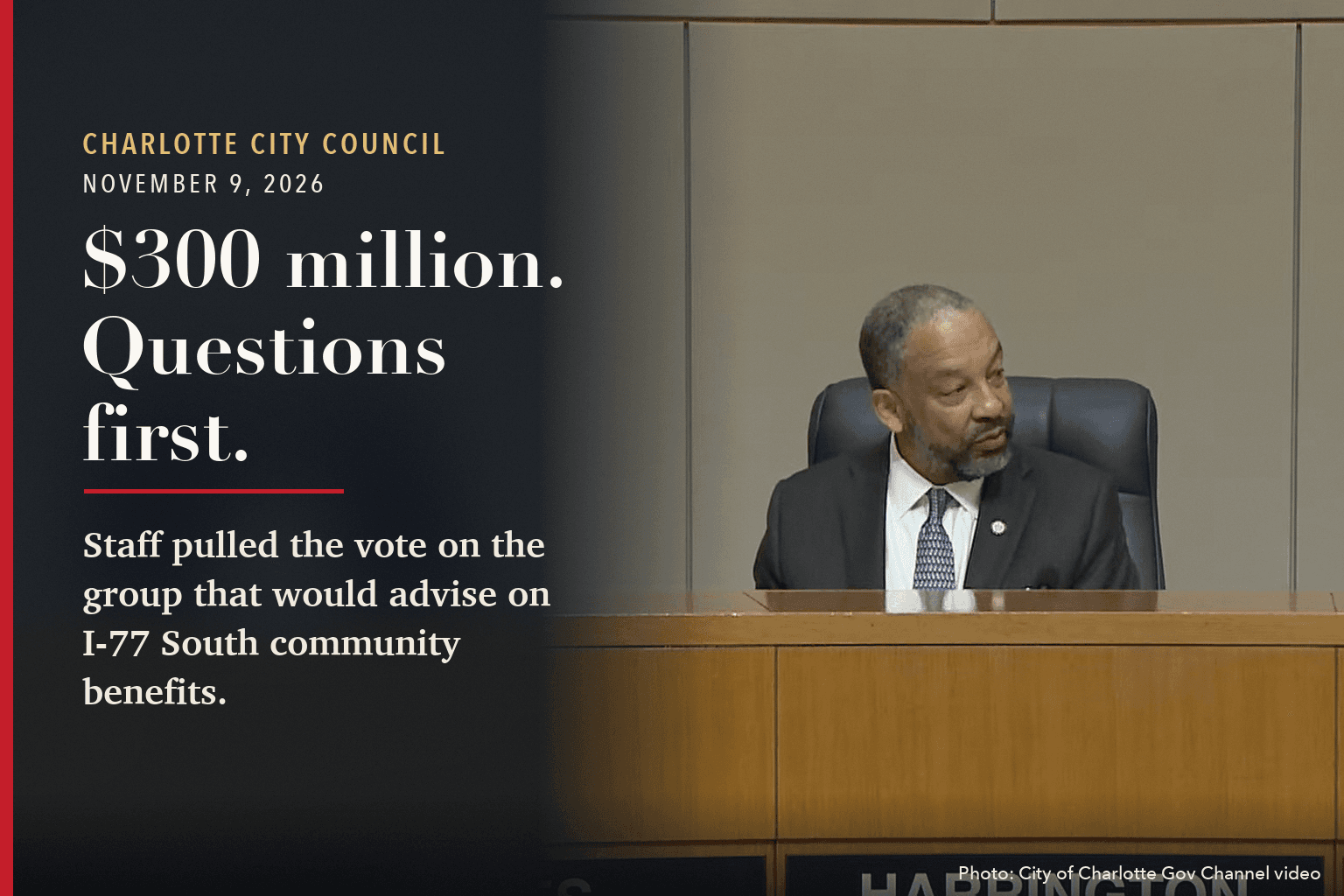
The neighborhoods along Interstate 77 South have been promised at least $300 million. They were also promised a say in how it is spent: a working group with nine seats for people who live, work or lead a congregation or school along the corridor. That group still does not exist. City staff pulled the Charlotte City Council's vote to create it Monday, Nov. 9.
Mayor Rob Harrington said the item would return on a future agenda after staff answered council members' questions about the working group. "We had a number of questions and have not had time to work through them properly," he said. He did not give a date.
Committee took no vote
On Tuesday, Nov. 3, Harrington had asked the council's Budget, Governance and Intergovernmental Relations Committee to work out the city's part in the benefits plan, starting with how the group's members would be picked. The committee's agenda called for a vote on that selection process Thursday, Nov. 5. The committee took none. The full council's agenda, printed Nov. 4, a day before the committee met, already listed Monday's vote.
At the committee meeting, its chair, Council Member Malcolm Graham, said the schedule worried him. "The timeline does draw me a little pause because it's fast," he said. Harrington, speaking next, said Monday's vote covered only the group's structure, and that moving quickly would keep the work on track to deliver by next summer. Council Member Dimple Ajmera agreed that the timing felt rushed. Council Member Dante Anderson, who represents District 1, said she would rather the state transportation department have one seat instead of two, with the second going back to the council's general pool. Graham closed the item after about an hour and said it would come up again Monday.
Council Member Reneé Johnson, who represents District 4, made a related point Monday night, during the debate on the airport's airline lease. A commitment council made in March 2025 to address the city's procurement policy, the rules for how the city picks its contractors, was still unresolved more than 19 months later, she said. The I-77 work group referral, she said, "was addressed in neck-breaking speed, even before some council members realized that it had been made."
I-77 benefits agreement
The group comes from the agreement the city and the N.C. Department of Transportation signed Sept. 22, the day after council rescinded its May vote against the planned toll lanes on 11 miles of I-77 between the South Carolina line and uptown. The state committed at least $300 million to the communities the highway affects, as we reported in October. The neighborhoods cannot enforce that agreement; only the city and the state can. The working group is the role it gives them instead.
Working group plan: 14 members
Under the plan staff put before council, the group would have 14 members:
- Eleven community members: three named by the mayor, six by council and two by the state. Three of council's six would be picked by the council members for Districts 1, 2 and 3, which the plan calls the impacted districts.
- Three government members, two from the city and one from the state, without a vote.
- Nine of the 11 community members would need a tie to the corridor or the neighborhoods around it: living there, owning or running a business there, or leading or serving at a faith or academic institution there. The other two could live anywhere in Charlotte.
The group would only advise. It could not commit public money, sign contracts or bind the city or the state. The agreement calls for it to meet at least monthly until the final benefits plan is set.